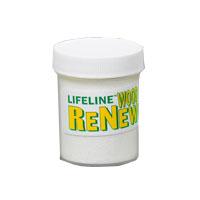
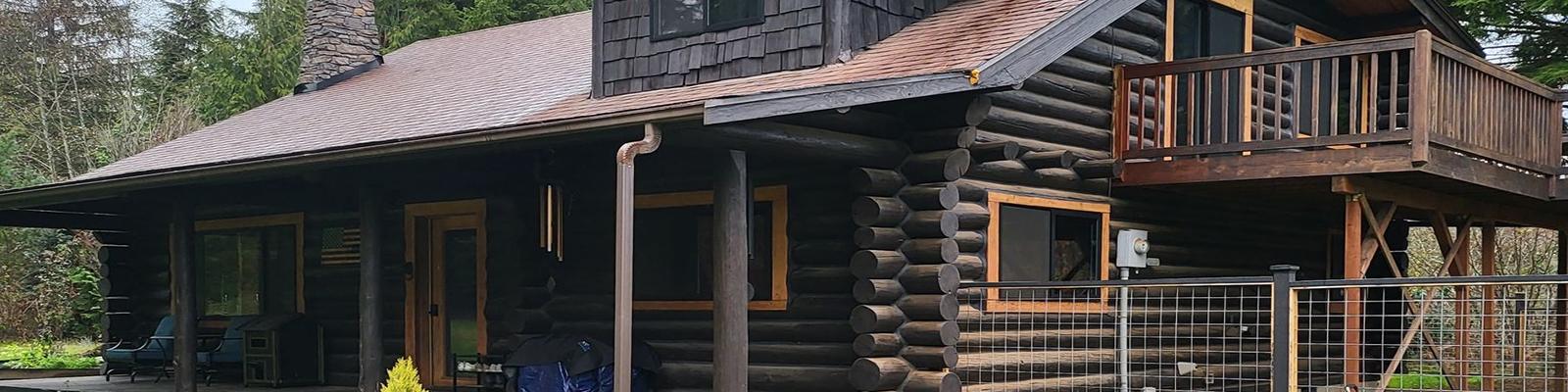
Wood ReNew
Sodium Percarbonate Wood Cleaner and Restorer
Gray, weathered wood often needs more than routine washing. Renew wood finish projects excel after ultraviolet exposure changes the surface or stubborn discoloration remains after normal cleaning.
Wood ReNew restores exterior wood without relying on harsh chlorine bleach. It prepares surfaces for the next step while helping bring back a cleaner, more uniform appearance before refinishing.
The formula contains a thickener that helps it adhere to log walls and siding. Use it to return wood to its original natural color before applying any of our quality wood finishes.
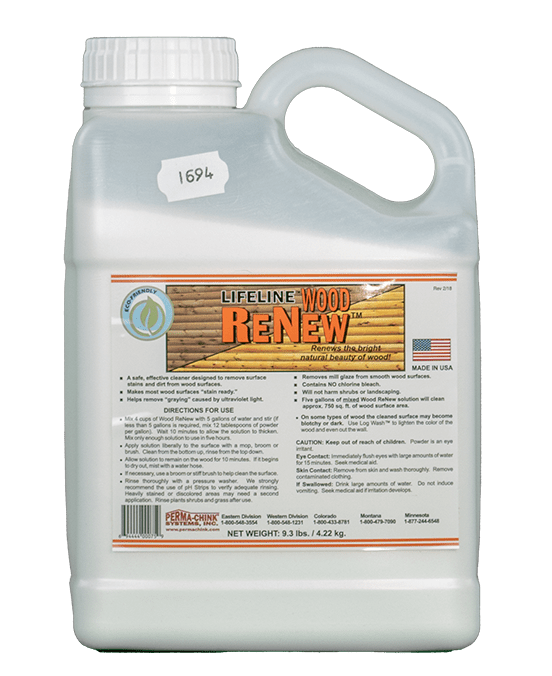
Shop Available Sizes
Weathering affects every project differently. Renew wood finish is available in convenient purchasing options that help match the amount of cleaner to the condition and size of the surface being restored.
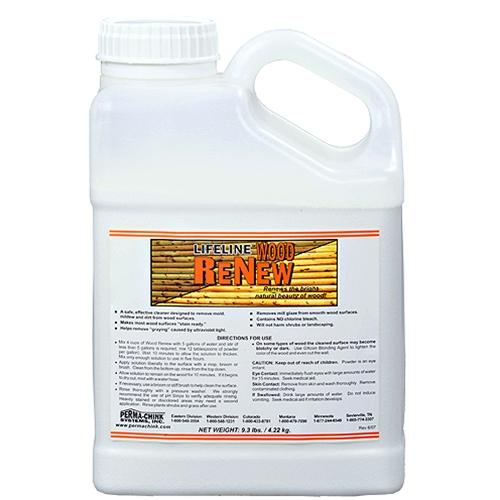
Product Information
Wood renewal products offer advantages beyond surface restoration. Perma-Chink delivers dependable performance while helping simplify demanding exterior cleaning projects.
Features
- Removes Gray Weathered Wood
- Treats Water Stains
- Removes Mill Glaze
- Restores Wood to its Natural Color
- Ideal for cleaning a deck with sodium percarbonate
Resource Links
How to Store
Extended storage is common between restoration jobs. Reseal wood renewal products after use and keep the container upright to help preserve product consistency. Check the contents before the next project and mix if separation has occurred.
How to Apply
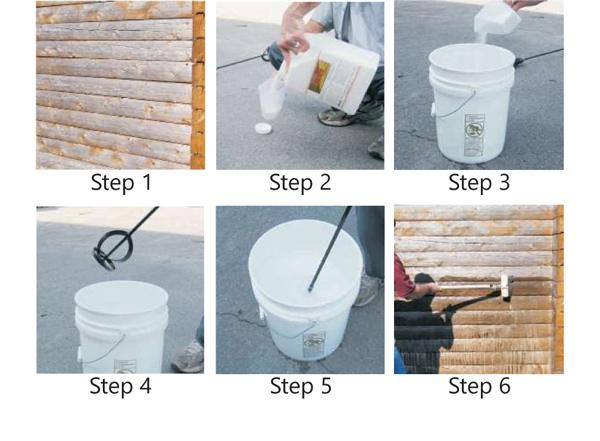
Coverage is easier to control on a thoroughly dampened surface. Apply renew wood finish evenly and let it fizz. That indicates an attack on dirt and grime. Wait ten minutes for the process to complete. Then, scrub the area and rinse thoroughly. Wood ReNew should not be used for spot cleaning since it may cause blotching of the surface.
Maintenance
Sun, rain, and shade affect walls in different ways. Walk around the home during routine exterior maintenance and watch for sections that begin losing a uniform appearance. Planning the next full cleaning before discoloration becomes widespread helps produce more consistent results.
Application Temperature
40° to 90°F
Application Methods
- Mop, brush, or sponge
Special Instructions
- Apply from bottom-up, rinse from top-down
- Rinse thoroughly
Shelf Life
5 Years
Frequency
As needed
Coverage Rate
- 2800-3000 square feet / gallon
Application Tech Tips
Cleaning Bare Wood Surfaces
For new or stripped logs, cleaning the logs before applying a finish and sealant is a critical step to ensure a superior outcome. Read more.
Cleaning Guidelines
New log homes and log homes being restored have different requirements for ensuring a quality project. Read more.
Recommended Products
Frequently Asked Questions
Cleaner FAQ
Why do I need to wash my log home?
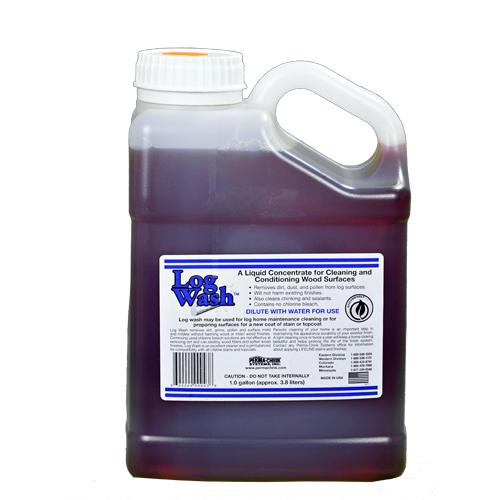
Log homes tend to collect more dirt and debris because of the rounded logs. The top of the log collects debris, making the home look dirty. Log Wash is designed to keep your home looking great and maintaining an excellent finish.
Which cleaner do I need for my log home?
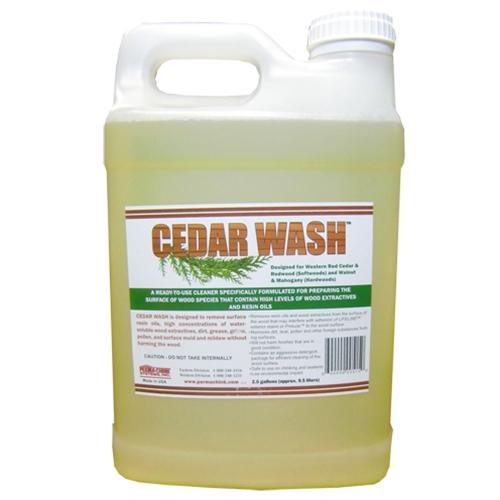
We offer two cleaners, Log Wash and Cedar Wash. Most log homes will use Log Wash, but homes with Cedar, Redwoods, etc., will need Cedar Wash. Read more about choosing the right one here.
How do I treat dark stains or grayed wood?
We offer two products designed to restore the bare wood from stains and weathering – Oxcon and Wood ReNew. Read more about what they do here.
Over the past several years we have discovered many things about cleaning wood and existing finishes. First and most importantly is that chlorine bleach is not the best product to use. In addition to its potential for damaging the finish and bare wood fibers, its use and misuse contribute to specific problems including the loss of film adhesion, discolorations due to tannin extraction, streaks, blotches, and premature failures of the finish system. We have also discovered that many wood and deck cleaners available at paint and hardware stores, home improvement centers and Do-It-Yourself outlets contain components that interfere with the proper performance of our finish systems.
Therefore, we have decided that the only cleaning products approved for use with our finishes are those products supplied or recommended by Perma-Chink Systems, Inc. We are not doing this to increase our sales of cleaning products. It is because we have tested our cleaning products with our finish systems and have confidence that when properly used and applied, their use will result in the best possible appearance and performance of the final LIFELINE finish. We can not say the same about the use of other types and brands of wood cleaners, and strongly discourage their use with any of our LIFELINE stains.
Guidelines for Cleaning Bare Wood Prior to Applying Lifeline Stains
New Log Homes
- If the wood has not grayed, wash the surface with a two (2) cups per gallon Log Wash™ solution and a pressure washer no more than seven (7) days prior to staining. Smooth log siding should be washed using Wood ReNew™. Rinse well and allow the wood to dry.
- If you are finishing Western Red Cedar, Redwood, Walnut, or Mahogany, use Cedar Wash™, a ready-to-use cleaner, instead of Log Wash for better surface preparation and finish longevity on these specific wood substrates.
- If there are signs of grayed wood, use Wood ReNew according to the label along with a pressure washer. Rinse well and allow wood surfaces to dry before staining. If more than seven (7) days pass before the home is ready for staining, wash the surface with a two (2) cups per gallon of water Log Wash solution, rinse well with a garden hose, and allow wood surface to dry.
- If, after steps one or two, there are still dark streaks or discolorations on the surface, use a solution of OxCon™, which contains oxalic acid, on the entire wall according to the directions for use. Rinse well and allow the wood to dry before staining.
Older Log Homes That Have Had a Previous Finish Removed
- If there are no signs of gray surface wood, wash the surface with a two (2) cups per gallon Log Wash solution no more than seven (7) days prior to staining. Rinse well and allow the wood to dry.
- If you are finishing Western Red Cedar, Redwood, Walnut, or Mahogany, use Cedar Wash, a ready-to-use cleaner, instead of Log Wash for better surface preparation and finish longevity on these specific wood substrates.
- If there are areas where grayed wood is still evident or if the wood has darkened after the finish was removed, use Wood ReNew according to the label along with a pressure washer. Rinse well and allow the wood to dry before staining. If the wood has darkened or more than seven days has passed before the home is ready for staining, wash the surface with a two (2) cups per gallon of water Log Wash solution, rinse well with a garden hose, and allow the wood surface dry.
- If, after steps #1 or #2, there are still dark streaks or discolorations on the surface, use OxCon, an aqueous oxalic acid solution, on the entire wall according to the directions for use. Rinse well and allow the wood to dry before staining.
Log Homes with an Existing Finish That is Still in Good Condition
- If a maintenance coat of Lifeline stain or topcoat is going to be applied over an existing Lifeline finish, wash the coating surface with a two (2) cups per gallon Log Wash solution no more than seven (7) days prior to staining. Pressure washing is not recommended. Rinse well and allow the wood to dry. For maintenance cleaning of finished surfaces that are not going to be stained or top-coated, use a one (1) cup per gallon Log Wash solution.
A Note About Rinsing
No matter what product you use to clean bare wood, nothing is more important than making sure you have adequately rinsed the surface. Any chemical residue remaining on the surface can have serious consequences later on. We always recommend using pH Strips to make sure that the surface of the wood has been sufficiently rinsed. A pH between 6.5 and 7.5 indicates the surface has been properly rinsed. pH Strips are available at most pool supply dealers, aquarium supply shops and Perma-Chink Systems, Inc. They are not expensive, are very easy to use and a great tool to ensure adequate rinsing.
Learning about Mold and Mildew
Mold and mildew are terms that are used interchangeably since they refer to the same living micro-organisms. For simplicity we’ll refer to them as molds. Molds encompass a wide range of fungal species that can live on the surface most materials, including wood. They require air, water, and food. Their color is usually white or black, but can be just about any color. If the growth is green, it’s probably a plant-like organism called algae.
The molds that concern us live on wood fibers or even on finished surfaces. Bare green wood is very susceptible to mold growth since the high moisture content provides lots of available water, and the wood’s nutrients are readily available as food. Many types of mold grow on green wood. They vary from black spots to white tendrils (commonly called dog hair). All mold growth MUST be removed before any of our LIFELINE™ finishes are applied.
Use Specialized Cleaners not Bleach
While common household bleach has traditionally been used to remove mold, it should never be used on bare wood surfaces. It is fairly easy to remove mold and prevent their reappearance underneath our finishes without having to use caustic wood-damaging chemicals like chlorine bleach. Wood cleaning products like Wood ReNew™ and Log Wash™ usually do an excellent job when used correctly.
Know Where Mold and Mildew Grows
All of our exterior stains and topcoats contain dry film preservatives that help prevent the growth of mold on the surface of the finish. They do not prevent the growth of mold on the substrate under the finish. That’s why it’s so important to thoroughly clean the surface prior to applying the first coat of stain or primer. Mold spots forming under a finish is an indication that the surface was not properly cleaned during preparation. The only way to remove them is to strip the finish down to bare wood to get at the mold.
Occasionally shaded, warm, moist environments can create conditions so conducive to mold growth that they can overcome the preservative or mildewcide additives contained in the finish.

Prevent Mold and Mildew
One way to handle this type of situation is to thoroughly clean the walls with Log Wash and then apply a coat of Advance™ Clear Topcoat mixed with a Mildew-X additive. Just be aware that the addition of Mildew-X will diminish the reflectivity – or gloss – of Advance Gloss.
A final thought about maintenance of exterior finishes: An occasional wash with Log Wash will help keep the surface clean and mold-free. If needed, a maintenance coat of Lifeline Advance will renew the water repellants, UV inhibitors, and the mildewcides. Cleaning and maintaining your exterior finish will protect the wood and maintain the appearance of your home, including keeping it free of surface mold.