
Blog & News
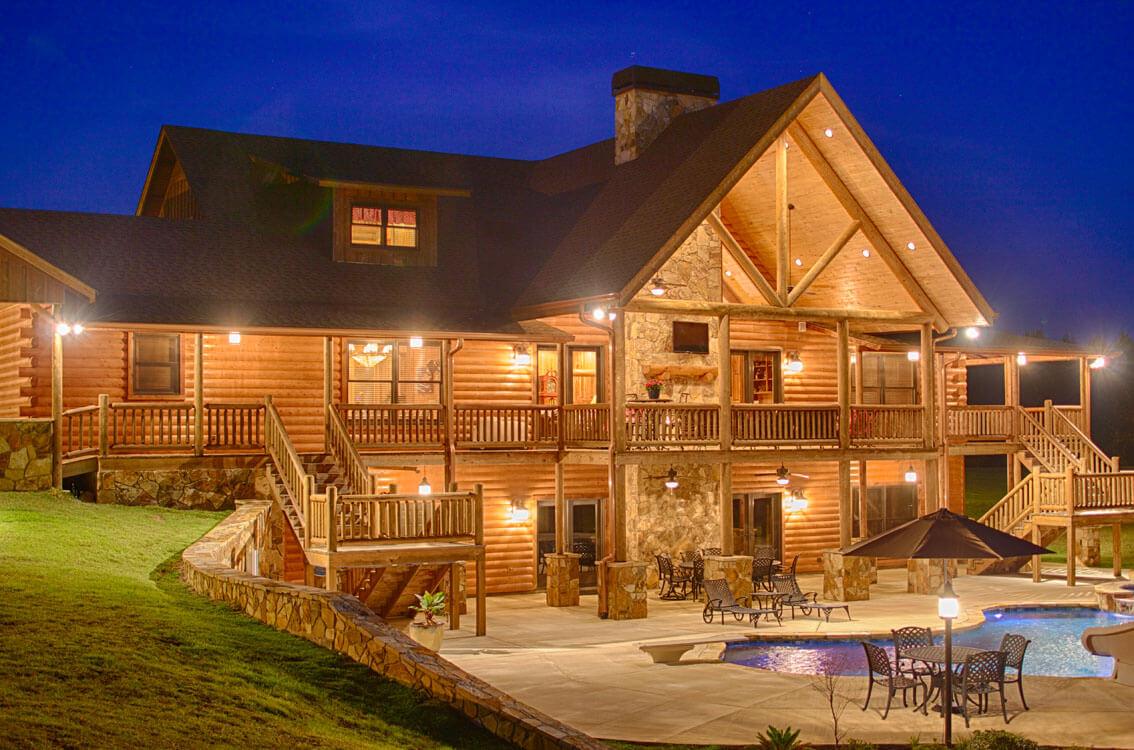
What are the benefits of using a top quality finish on a log home?
Whether you’re currently building your dream log home or simply checking off tasks on your annual home-maintenance “to do” list, we’re always looking for ways to skimp on expenses around the house. But when it comes to putting your best foot forward with a beautifully stained home that’s also protected from the exterior elements, you might want to think twice before being lured in by the lower price tag of a middle-of-the-road finishing product.
Think about it: Not only does a stain and finish define the aesthetic appeal of your log home, enhancing the striking beauty of the wood’s grain and natural color, but it serves as a shield for your home’s most precious building blocks – the logs. Because of this, it makes sense to spend the extra money upfront on a high-quality finish for your home. And, as it turns out, if you can swing the higher cost for the first application, you will save yourself oodles of cash over the lifetime of your log home.
What are the qualities to look for in a top quality log home finish?
To ensure a successful and long-lasting result, you’ll also need to consider factors like wood protection, maintenance and, of course, appearance.
Appearance: In addition to building a quality home, you want to build a beautiful home, which is why the finished appearance of your logs is so important. By spending a little bit more upfront, you’ll get a distinguished looking wood finish that will set your home apart from the rest.
A high performance finish gives long-lasting color retention through the use of a balanced formulation of transparent iron oxides and long lasting mildew inhibitors. By applying a clear topcoat, you also have the opportunity to create a gloss or satin finish and greatly extend the life of the stain system.
Longevity: With a high-quality product, comes high performance and longevity. The most important duty of your home’s finish is to shield your logs from the elements, including UV rays and water. While UV inhibitors are included in some high-quality stains, your finish should also repel rain but be permeable to water vapor to allow trapped moisture in your logs to evaporate. For topcoats and base stain, Lifeline™ provides you with options that “breathe,” allowing moisture within the logs to evaporate while reducing checking. Clear topcoats boost protection against UV rays and add water repellency – while making your exterior walls easier to clean. The smooth surface of a high-quality clear coat repels dirt and dust, making cleaning a breeze.
Value: There is no doubt that high-quality finishes will save you time and money in the long run. Lasting longer equates to less labor expense over the life of the finish. A high performance stain will typically last 5 to 8 years while low quality stain will expose your home to the elements in two years or less. High-quality finishes make the job go faster, cover larger square footage and require less maintenance over the years.
Environment: A high-quality stain should be formulated to meet and exceed emission standards established by the EPA (Environmental Protection Agency) as well as all state and local restrictions. Finishes should also be free of formaldehyde which is a known carcinogen.
Over the past few years almost all new innovations in coating technology have been in low VOC (Volatile Organic Compounds) water-based systems. This new technology has allowed the development of high quality products like Lifeline™ Ultra stains and Advance™ topcoats that not only look great but meet the most stringent environmental requirements in every state.
How do top quality finishes differ from the average finish, like one you could pick up at the local hardware store?
All stains differ in their lifespan, coverage rate and quality of appearance and protection. One of the most important aesthetic considerations for log home owners is stain color and tone. It seems like most stains look great right after they are applied but will that beauty stand the test of time? By choosing a high-performance finish like Lifeline™ Ultra-7, you are ensuring that the finish will look as beautiful years after application as it did the second day it was applied thanks to a balanced formula of transparent iron oxides, mildew inhibitors and an advanced polymer resin.
Here’s how it works: The transparent iron oxides protect your logs without resulting in a “painted” look that hides the natural texture and beauty of the wood grain. Plus, these pigments provide superior UV protection, blocking the fading and bleaching effects of the sun for a much longer period of time. In addition, the mildew-fighting components will help prevent any mildew or mold from growing in the finish itself, which will greatly reduce further discolorations on your logs.
Next is the durability. The secret behind durability of Lifeline™ Ultra-7 is state-of-the-art resin that creates a flexible and tough seal on your home’s logs. Perhaps more importantly than the seal’s strength, the resin also ensures that the seal is continuous, providing protection from holes and gaps that might otherwise develop with a lower-quality finish. In addition it has unsurpassed adhesion to wood. It’s this continuity that has proven to be much more resistant to UV degradation, color fading and adhesion loss.
The total cost for finishing your log home includes labor, tools and the materials involved in preparation of the wood surface, application of the finish and maintenance of that finish. When you consider the cost, it’s important to include the total, long-term cost of the stain that you choose.
For an average-size log home, labor costs for finishing would typically be about $4,500. In addition, about 20 gallons of stain would be needed to apply two coats to the home. For an ordinary stain, let’s say the cost per gallon is $30, totaling $600 for the entire job. Add in $4,500 for labor, and the total cost of the job is $5,100.
Field tests show that the job will last two years, the cost per year of service would be $2,550.
Now let’s take a look at the cost for a top-quality, 100-percent acrylic stain. At a cost of somewhere around $90 per gallon, the cost for 20 gallons would be $1,800. Again, the labor would be $4,500, so the total would be $6,300 – a significant increase from the lower-priced product. But, since the stain job will last at least five years, the cost per year of service would only come out to $1,260 – less than half the yearly cost of the “budget” stain job!
It’s no surprise that high-quality products from Perma-Chink Systems’ extensive collection of exterior finishes and stains will result in spending less time and money protecting and maintaining your log home over the years!
Is a quality finish maintenance-free? Lower maintenance? What type of maintenance is needed?
High-quality finishes require less maintenance over the years. Lifeline stains from Perma-Chink Systems are easy to apply and quick drying, so you can continue application without extended delays for drying. With our clear-coats you have the flexibility to perform maintenance with a minimum of labor and material costs. You can apply either color coats or clear coats over any surfaces requiring maintenance.
What are some of the things that can happen to a log home exterior if a low-quality finish is used?
Frequent maintenance maybe necessary due to water repellency, color fading, UV degradation, mold and mildew problems, holes and gaps might develop, etc.
Why does top quality typically mean higher cost? Is it the ingredients? Research?
Quality stains formulated with top-notch ingredients using the most advanced technology. Quality stains not necessary will cost more if you consider coverage, number of coats, years of service, labor cost.
Perma-Chink Systems Family of Finishes

My name is Mike Samuels. I am a Log Home owner and recently started working for Perma-Chink Systems. So let me tell you how my story begins. We are going back to my childhood. My parents vacationed in Smoky Mountains once or twice a year. As a child I was very impressible and excited any time I was able to go on vacation. The trip always included a drive through the mountains, sightseeing around Cades Cove and driving up the most treacherous Ski Mountain Road.
On every visit to the Smoky Mountains, I remember making comments to my mother that one day when I grow up, I would have a log home or mountain chalet here. I made a lot of wishes to my mother growing up just as any kid does. I am sure that my mother listened to my comments in one ear and out the other. She was always very encouraging. I also remember that I told her I would be an US Air Force fighter pilot. Not everything comes true, but there is nothing wrong with dreaming.
I worked for one company for 38 years, mostly living in Houston, TX but my wife, Kathy, children and I lived in Tennessee for a total of 10 of the 38 years. Unfortunately the Tennessee years were located in the middle and west Tennessee, never East Tennessee. However, many of our family vacations were still in Smokies. My children were overwhelmed with the breathtaking views of the mountains as much as I was as a child.
Fast forward 40 years. Where did the time go? It was finally time to think about retirement and where my wife and I would spend the remainder of our lives. The decision was not as easy as one would think. The first place many people want to retire is the beach. That was our first idea, but Kathy and I looked at each other and simultaneously we said, How about Smokies, and How about a Log Home?
Kathy immediately logged on to the Internet and starting looking at land for sale. I can tell you that once my wife has a mission, she reacts quickly and thoroughly. Within minutes she found several pieces of property for sell. Of course, this would mean another vacation to Smoky Mountains to look and buy land. She planned out a trip, contacted a Real Estate company and put everything in motion.
We picked out approximately 10 properties to look at. Our real estate agent met us at the hotel around 8am on a Saturday. An early start was essential in order to look at all of the properties in a couple of days. It was rainy and cold. I believe the trip was in March, the best I can remember. We made it to all of the properties on Saturday… a very long Saturday. Kathy and I were a little car sick from the winding mountains roads and disappointed, because none of the properties made any significant impact on us.
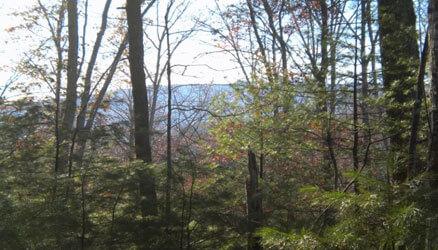
Early on Sunday morning the rain had stopped so my wife and I decided to go out and search on our own for the perfect piece of land. What a difference does good weather makes. Kathy and I parked the car and started walking. We made it about half way up the property and were able to see nothing but trees and hillsides all around. We envisioned how a house would sit on the hillside. We walked up to the top of the hillside and there was this great view of mountain tops. At that time, we knew this was the right property to build our log dream home and spend the rest of our lives here. We made an offer, countered and purchased the same day on a Sunday.
As I mentioned earlier, Kathy is not one to sit back and wait for things to happen. She now has the land. It was time to start planning next steps. We both were still several years away from retirement but that did not stop us. She continued to plan. She contacted what seemed to be 100 manufactures, builders, and purchased tons of Log Home magazines and publications. Being a good husband, I sat back and allowed her to make floor plan decisions and building styles. I knew that my goal in life was to keep her happy. The design of the house was not my main concern. I like spending time outdoors, so as long as I had a place to eat and sleep I would be happy. We lived in five different homes but never one that would take on this feat. Most of our home purchases were buying new and vacant so we could move right in.
Meanwhile, while Kathy was doing all of the Log Home research, we decided to get started on all the work it takes before you start to build. After Kathy compiled all of the Log home information, we could see our vision beginning to be a reality. First, we decided to have the land re-surveyed. A small price to pay for the comfort you got what you paid for. We were still six to eight years away from retirement and building. Our goal was to build and have the home complete about one year before our retirement. We wanted to work to age 58 before retiring and moving to the mountains.
Kathy and I vacationed about every six to eight weeks. All vacations now were, not to beaches or cruises, but to our piece of land heaven in the Smoky Mountains. After our first visit in the fall, our land was so overgrown we could not even walk on it. Vacationing to our future home was the worst thing we did, because at that time we decided to begin doing some excavation work. Living far away from your land is really a detriment. The key is finding good contractors, which is very difficult even without the distance between Houston, TX and Smoky Mountain Tennessee. In the case of identifying good contractors, “The more the Better”.
Our surveyor gave us a name of a contractor who could excavate. We call the excavator out along with about three other contractors to discuss options. We did end up with the contractor our surveyor recommended. Instead of only clearing land, we installed the septic tank, laid out the driveway, cleared about one acre of land and set the home site. Keep in mind that Kathy was still working on log home designs and floor plans, not to mention taking me many miles around the region to see and talk to log home manufacturers and look at model homes.
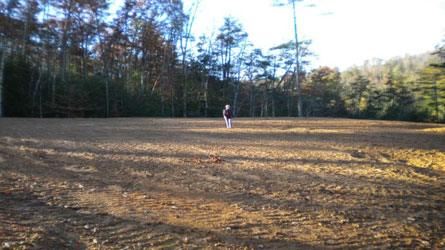
Our next vacation visit to the land was to see the outcome of the excavator’s work. The land looked fantastic. No longer did we need to walk up the hill and fight our ways through the heavy brush. We drove our car up the driveway and parked where one day the house would be. These vacations to the land made us want to build and move sooner than we planned. And we did.
After meeting and talking with several contractors we decided to go with someone who had extensive Log Home experience and managed a Log Home Resort complex. He was going to be our eyes on the ground. My wife actually took the role of general contractor. She did an amazing job. She ordered the Log home package, had it delivered and the log home manufacture completed the dry-in. A lot of work had to take place prior to the package being delivered. We decided to build the home into the hillside and build a basement garage under the home. Our excavator and surveyor had more work to do. Get the retaining walls, garage and basement ready prior to the delivery of the log home package. Our surveyor read the plans to install supports for the balcony and decks.
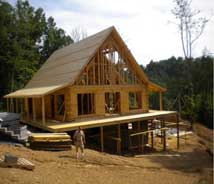
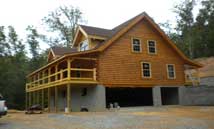
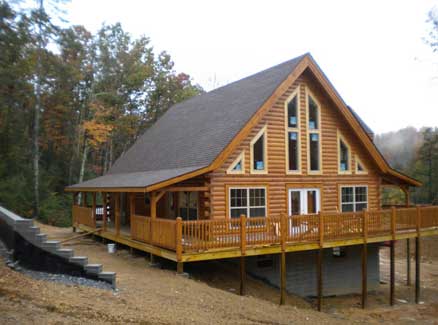
I wanted to get the home stained as soon as the dry-in was completed. Applicators in the area had many recommendations on which log home stain to use. Again, my wife and I did research on wood stains. After reading propaganda from websites we decided on Perma-Chink Systems products. Our decision was based primarily on a water-based product, especially when we saw the warranty available for Lifeline Ultra stains. Perma-Chink Systems was the only company that guaranteed their stain with a 5-year warranty if properly applied. Fortunately my eye on the ground in Smokies was also a Perma-Chink Systems distributor. I let my wife pick out the color. After 30+ years of marriage, I finally learned my lesson, “Keep a Wife Happy”.
Perma-Chink Systems delivers an excellent product, good warranty and ease of cleanup. All attributes of a good log home stain. Since Perma-Chink Systems has a family of products we felt that their overall systems were a good match for protection and longevity. We chose Dark Natural color in the Lifeline Ultra-2 line. We started with the Shell-Guard borate treatment, Log Wash wood cleaner, Lifeline stain and Advance gloss top coat. The house looked great.
One month after I turned 55 years old, we retired and now living in our new Log Home. Looking back on all of the hard work, frustrations, time spent, and even the occasional husband and wife arguments, we finally made it. It has been great living in a Log Home. What makes it better, is that my daughter purchased a log home about 10 miles from us on the lake. It is nice having family with you during your golden years. By the way, I stripped and stained her home using Perma-Chink Systems products as well.
I have learned so much about log home maintenance and care for a Log Home. So much, that when I visited our local PCS store to get Log Wash, I also got a job. I am one of the newest employees here and I am still learning how to maintain our home.
My biggest lesson for anyone wanting to build a log home is planning, from start to finish. Attend as many log home seminars that you can. Perma-Chink offers excellent seminars for the do-it-yourself home owners. Take advantage of the Perma-Chink Systems experts and utilize their personnel to get valuable advice. Call or visit any of the locations to get personalized service. Call me at the Perma-Chink Systems in Sevierville, TN. I will be happy to share my experiences and will guide you for a long and happy life in your Log Home.
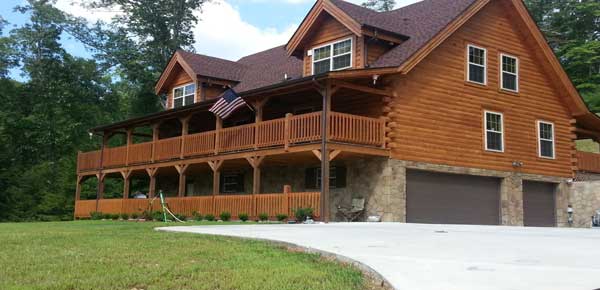

After graduating from college, the normal progression for most women is marriage. But, what is great, or even fun, about being normal? This neo-Laura Ingalls-Wilder, this Backwoods Barbie, embarked upon an adventure. I decided to build a log cabin!
I have had the pleasure of being around log cabins nearly my whole life. I grew up in my parents’ pine, D-shaped log cabin. They had a “turn-key” package; but we, mainly my father, ended up doing a lot of the work. Despite three children, pets, and fluctuating Alabama weather, their home has weathered nicely with little maintenance. Therefore, my parents are supportive of my log cabin, although they enjoy ribbing me about some comments I made when I was about ten years old.
I was ticked at my mother because she did not think that a black and silver waterbed (completed, of course) with a zebra bedspread was suitable décor for a ten year-old girl’s log bedroom. Thus, I declared that I would never have a house of wood. I vowed to have only wallpaper and paint in my house one day. (Never say never!)
Anyway, my adventure started when I found an ad for oak log cabin kits in a classified newspaper. Not wanting to be saddled with a large debt and realizing that I would be responsible for cleaning and maintaining the house, I decided to purchase the approximately 1,500 square-foot kit. The logs arrived safely and beautifully – Missouri oak heartwood dovetail logs.(Say that ten times fast!)
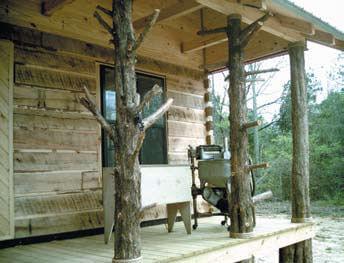
Since my kit consisted of only the perimeter wall logs, I drew the interior plans one Sunday afternoon; and Mom and I devised a plan that would allow me to “pay-as-I-go” and have the cabin completed and paid-off in three years. However, I did not realize how much I was going to be involved with the “hands-on” construction, and I never imagined how much I would learn to do and end up doing myself.
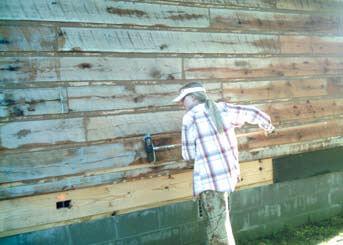
I hired an experienced carpenter to oversee my project (I later hired some helpers for a few days). My brother Tubby and the carpenter laid the block, and I started helping with the setting of the logs. Tubby would sing “John Henry” as he swung the sledge hammer! Our carpenter joked, saying he felt like he was building a pyramid. Dad, Mom, and I cut cedars for the porch posts (Mom and I caught poison oak to prove it) and hemlocks for the supporting interior posts. I wanted some octagon windows, but I could not justify the special order price. However, I found new ones (although the wrong color but paint corrected that) at a flea market for 1/10th the special order store price. Mom and I shopped ‘round and ‘round for the additional lumber at the best prices.
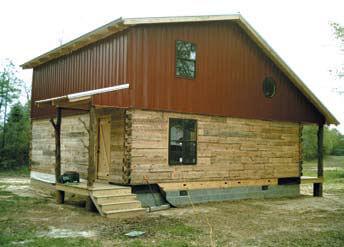
Before Mom and I started preserving the logs and additional lumber, Mom and I attended a Perma-Chink Systems workshop in Rome, Georgia. We learned countless tips and acquired useful information that has saved me both valuable time and money. (My father was very impressed when I informed him of what pressure-washing tip, at what pressure, and at what angle I had to wash the logs.) Mom and I painstakingly followed all the Perma-Chink products’ directions. The Energy Seal far surpassed any other similar product in both ease of application and appearance during the sealing of the dovetail corners and joints. This very time-consuming task made me feel like the “Human Dirt Dauber,” and I lost track of how many hours I spent on this job. However, my leaks during pressure-washing were mostly confined to around the windows and doors that had not been trimmed at that time. The Log Wash, Wood ReNew, Armor-Guard, Log End Seal, Lifeline Ultra-2 exterior stain, Lifeline Advance clear topcoat and Cobra Rods were quickly and very easily applied or utilized.
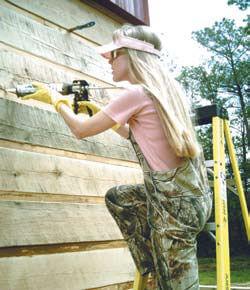
Painting the 2X4’s with Chink-Paint was another time-consuming task. I completed this step fully by myself. If stacking the logs felt like building a pyramid, this step could be compared to engraving the hieroglyphics onto the stone pyramid walls. (One thing I quickly learned during chink painting is that it is much better to paint slowly and clean-up less than to paint quickly and clean-up more!) Mom and I were both surprised and impressed with the Lifeline Advance Exterior Gloss topcoat. When we cleaned out the containers from which we were applying, the dried Lifeline Advance peeled out like plastic wrap. I feel as if my cabin is securely plastic-wrapped from the elements.
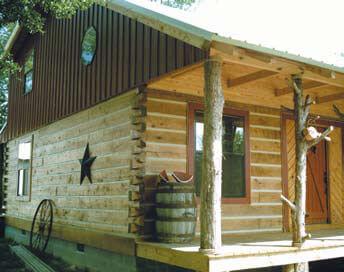
The interior Perma-Chink Systems products worked as well as and look as great as the exterior products. Prelude beautifully prepared the interior logs for the Lifeline Interior stain. The Lifeline Interior stain and the Sure Shine Gloss look fantastic on the many different types of interior wood – oak, pine, spruce, hemlock, and hickory. The Chink Paint also looks nice on the interior walls.
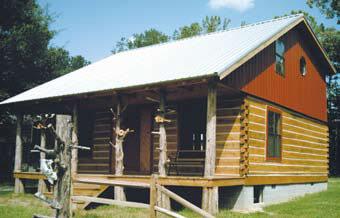
With the assistance of good helpers and the employment of recycling, creativity, gifts from generous friends, and affordable Perma-Chink Systems products, the exterior of my cabin is already completed and much of the interior is completed in only six months. My cabin is debt-free and is more beautiful than I ever dreamed that it would be. Before preserving the logs, I was concerned that by doing anything to the logs, I was going to destroy their natural beauty. (Boy, was I mistaken!) The Perma-Chink products are not only protecting, but also enhancing my logs’ natural beauty. Before using some of the products, I doubted the necessity of using them. (Boy, was I mistaken again.) Each easily applied Perma-Chink Systems product is necessary for a beautiful, protective complete finish.
My adventure has changed me both mentally and physically. I am stronger, wiser, more grateful, and more selfsufficient. It has given me a strong sense of accomplishment. When someone asks me about my home, I am able to show them my hands and say that I’ve built my cabin with these two hands (despite the nail polish) and with the help of some good folks and great Perma-Chink Systems products.
“The Wise Woman Builds Her House” PROVERBS 14:1
By Mala Patterson,
Bluegrass Musician
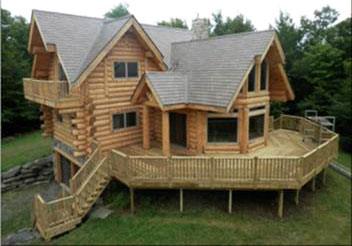
The Leroy Mountain project was in need of some help. Built in 2003 it had been coated with Sansin Classic. One product, one color had been used on everything- logs, trim, and deck. This resulted in a mono-tone appearance. A second and third coat had been applied over the years, without adequate preparation. On one wall it looked like the finish had not been stirred or mixed before applying. Time, sun and weather had degraded the exterior badly. It was sad to see such a beautiful home in this condition.
My first impression on seeing the house was “Whoa, what is that little gem doing here?” Large Doug Fir logs, scribed fit, three gables, two balconies, two dormers, two porches, hexagon great room and deck – all tucked in on a basic footprint of 32’ X 32’. This is not your typical Pennsylvania log home. The log kit was supplied by The Log Connection, British Columbia, Canada. As soon as I saw it I knew we could bring it back to better then new looking condition.
The first step was cleaning the home. Seventy eight bags of New Age crushed glass blasting media were used to remove all the old finishes from the logs and deck. Next we sanded the logs down using random orbital sanders with 60 grit and then an Osbourne Brush. Special attention was paid to the logs ends, smoothing them out and chamfering the edges. We also smoothed out all the deck top railings, posts and hand rails to ensure a nice feel when touched.
Porcupines had climbed all the log corners and chewed some pretty large areas. Some spots could be sanded out, others were repaired using M-Balm and E-Wood. After sanding the E-Wood smooth I brushed a light coating of Energy Seal over the repaired area so that when stained it blended right in.
We soaked the bare logs with thirty gallons of ShellGuard RTU then sealed all the log courses, corners and intersections with six pails of Energy Seal “Adobe”. The house was then washed with Log Wash and allowed to dry.
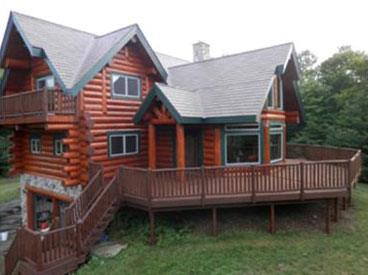
First coat of finish required fifteen gallons of Prelude, a clear primer/sealer with UV inhibitors. Two coats of Lifeline Ultra2 “Bronze” were next, requiring twenty three gallons. The last coat was nine gallons of Lifeline Advance Gloss. All finishes were sprayed on using a Graco Tradeworks 170 with a 313 tip and back brushed with a StainMaster brush.
Window trim and fascia were painted with Sherwin Williams Super Trim Paint in a rich, deep, pine tree green. This extra step did require a lot of time and effort but really set off the details of the home and complimented the color of the logs.
Deck and railing were coated with twenty five gallons of “Hickory” Deck Defense.
The project took one man, six weeks, 317 hours to complete. When I started the project in late July I did not have a firm deadline nor did I know of the family reunion occurring on Labor Day Weekend. I really had to hustle to finish, putting the final touches on the deck just in time. It was worth the effort, as the owners and his extended family love their better then new home.
Brian O’Shea
Log Home Restoration
Wellsboro, PA
By Tony Huddleston
VP of Sales and Operations, Perma-Chink Systems
Log home living in today’s world can be linked to the same pioneer spirit that helped many of our ancestors forge a new world. The spirit that dwells in so many of us tells us that we want something different from all the rest. Something that enables us to have a different way of expressing our lifestyle that embodies the individuality in some of us that separates us from the masses.
The months or years that are spent researching log home styles, construction methods, visits to dealers and talking with homeowners about their homes are brought to reality when we finally move into a new log home. Hopefully during our quest for the home we wanted that our dealer advised us to plan for maintenance and to design our homes to be “maintenance friendly”. After all we, like our homes are not going to be forever young, so planning for maintenance down the road will pay off big dividends in years to come.
Today’s log homes are not the same homes our ancestors built, as they were often built strictly as a necessity for their families. There were very few thoughts as to anything other than shelter and protection from the elements as well as other predators. Log homes of today are engineered to be structurally sound and take advantage of energy-saving features, much the same as other homes. They are no longer viewed as “cabins”; they are primary homes and second homes or vacation getaways.
Having said that, all of the engineering, planning, and choices you make should also include planning for scheduled maintenance on your home. Maintenance should not be viewed as a chore or just an expense, it should be considered as an investment in your homes’ longevity and value. Properly cared for; log homes will appreciate in value, rather than depreciate. Download the “Inspection Checklist” in PDF here.
If you are new to the lifestyle of log homes, then possibly you may be new to the care and feeding of a log home and may have some questions or reservations as to how this should be done. With a little planning and timely execution it is not as difficult as it may seem.
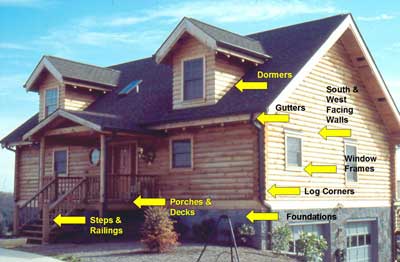
Starting with the basics; a walk around your home at least twice a year will help you become acquainted with your home and the condition of the sealants and finishes. If you do see something, get up close and personal to see what is happening. Pay close attention to the South and West sides of your home as that is normally the areas that catch most of the sun, and the ultraviolet rays that come with sunlight will cause those areas to show the quickest signs of needing maintenance. Many folks are under the impression that you always have to re-stain the entire home; when in fact all you may need is a touch up on the weathered side.
During your walk around, pay attention to the sealing system on your home, especially around doors and windows. As checking and fissure development is a naturally occurring process in large timbers, make note of any checks that face upward to catch water and hold moisture that may cause problems. Take special note of any that run behind door and window trim that may allow moisture to work its way to the interior. Also look for any telltale signs that your stain or finish is beginning to need attention; fading, peeling, or dark areas under the finish are good indicators that mean it is time for a maintenance coat.
Plan on washing your home at least once a year to remove all pollen, dirt and other airborne pollutants that may have settled on the surface, and no it does not always mean you have to pressure wash the home. Log Wash™ and a garden hose will remove most unwanted contaminants without hurting your homes finish. Many of the cleaners available today are not suited to clean your home, as they are often very aggressive and may contain chemicals that will be harmful to the finish as well as the landscaping. And contrary to some popular beliefs, bleach is not a cleaner and should not be used as it is not only dangerous to the user, but it also harmful for the environment and the wood on your home.
Any landscaping such as shrubs, bushes and vines should be trimmed back so as not to interfere with air circulation on your walls. The walls should be allowed to have good air circulation and landscaping that is touching the home will; over time scuff the finish and provide too much moisture to remain on the surface.
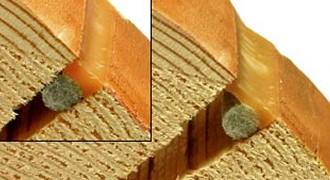
Remember those upward facing checks mentioned earlier? Those should be filled with Check Mate 2™ as it will standup to the natural opening and closing movement during climatic changes in weather. Inexpensive caulks may not fill the bill in this application, and actually may do more harm than good by creating troughs to catch even more water. Select a product that is designed for that purpose; and follow the directions provided to achieve success. Again any sealant that needs replacing or repairing should be done at the same time as well.
While you are doing your walk-around; look for any evidence of insect activity that could be the start of some unpleasant results. Things to look for include sawdust or “frass” that may be left from the activity of powder post beetles, also look for any signs of termite tunnels that lead from the ground up to the base log or lower plate. Take the proper action to eradicate these types’ of pests by calling the local pest control guy to help you with removal and prevention. Carpenter ants are pesky insects that do not actually eat the wood for food purposes, but they do damage by creating nesting areas in and around the home. Keeping your finish in good shape to prevent moisture accumulation will help to deter these pests, and all insects need water to survive. Store firewood away from the house as it is a haven for insects.

In today’s economic situation, energy conservation has become paramount due to higher energy cost, so you might consider having an energy audit on your home that includes a blower door test to locate any areas that are allowing air to enter or leave the home. In case you are wondering what a blower door test involves, a technician will install a seal over one door in your home and draw a vacuum on the entire structure. Once a certain level is obtained they will use an infrared camera and check for temperature changes that may indicate a leak. The results will be entered into a software program and it will be determined how much energy you may be losing, and solutions will be offered as to remediation. Many of the leaks can be easily sealed or eliminated by other means, so it does not always involve spending a lot of money. And yes, all homes and buildings do leak in some areas, no matter what construction type they are.
In summary, creating a simple maintenance plan for your home will eliminate the need for more expensive maintenance needs as time goes on. As the very old saying goes, “an ounce of prevention is worth a pound of cure” is also true on log home maintenance. Keep it simple, and keep it small and your home will love you for it.
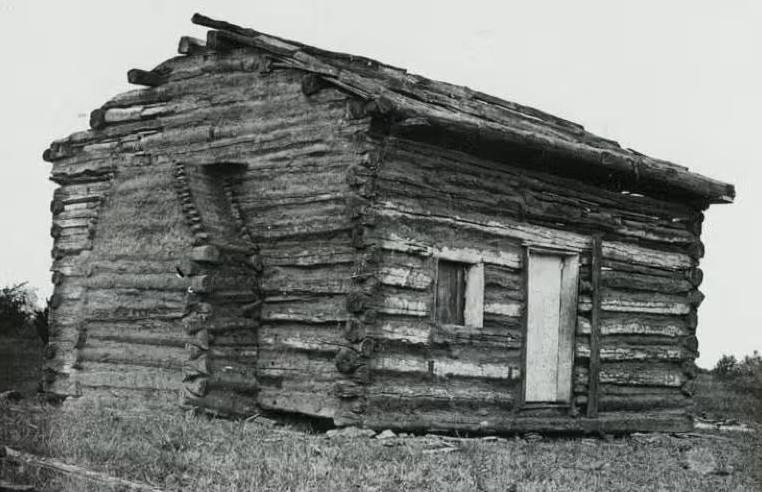
From Peter H. Miller, Traditional Building:
Not every great leader was born with wealth and privilege. In fact, some of the greatest U.S. presidents came from the most humble of abodes. Today we take a look at some of our favorite presidential birthplaces.
1) Abraham Lincoln
Arguably one of the greatest leaders in our nation’s history, Abraham Lincoln could not have come from a more humble beginning. This one-room cabin in Hodgenville, Kentucky, measured only 16 ft. x 18 ft., had a dirt floor, a stone fireplace, and a single window, featured at the top of the page.
2) Dwight Eisenhower
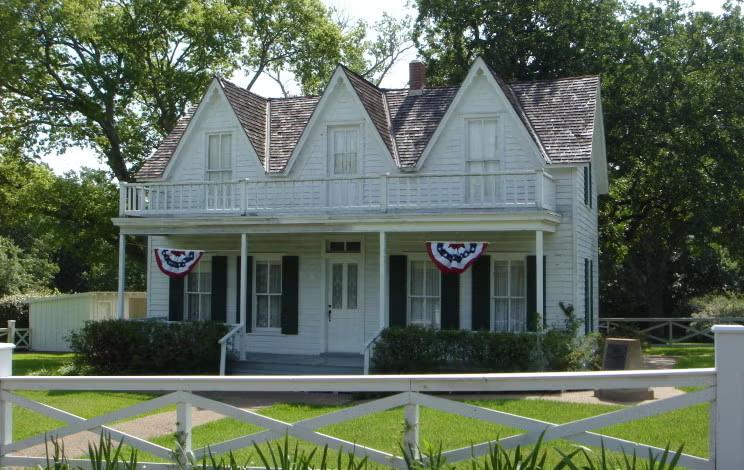
Dwight D. Eisenhower was born in this simple 2-story frame house in Denison, Texas. He was the first U.S. President from Texas–although he didn’t know that until he was an adult. Eisenhower’s family moved to Kansas when he was 2 years old, and he had no knowledge of his Texas origins until a local school principal named Jennie Jackson contacted him and asked if he was related to the Eisenhower family of Denison. Once Eisenhower’s mother confirmed that it was indeed his birthplace, Jackson set about raising funds to buy the home, which was then donated to the city of Denison. It is now operated by the Texas Historical Commission, and is a designated Texas Historic Landmark.
3) Bill Clinton
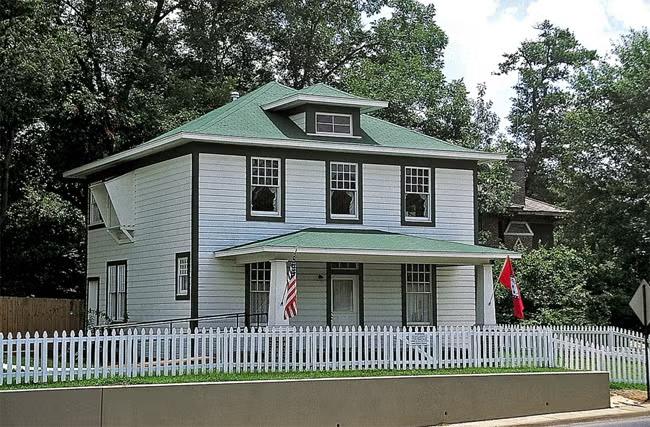
William Jefferson Clinton, our 42nd president, was born in the small town of Hope, Arkansas. He lived in this modest house in Hope with his recently-widowed mother and her parents until he was 4 years old. It was in this home that Clinton first learned about social equality, justice, and a commitment to serving others from his beloved grandfather.
4) John Adams
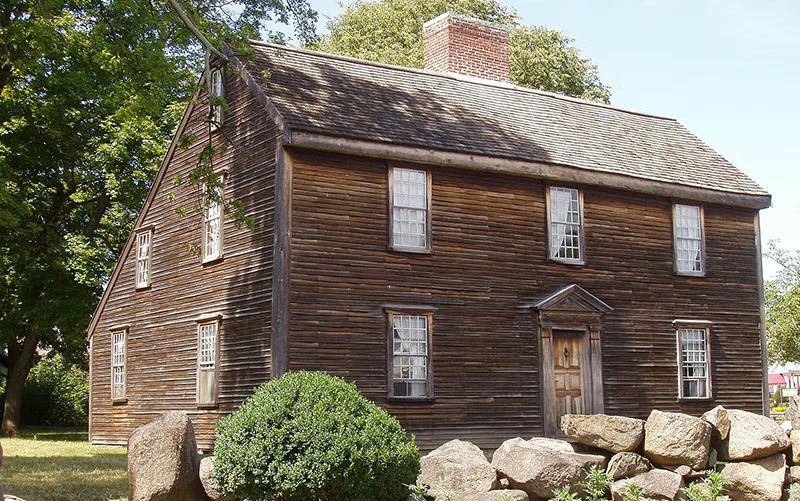
John Adams, the second president of the United States, was born in this Quincy, Massachusetts saltbox house that was built in 1681. This historic American colonial structure still stands in its original location, surrounded by the six acres of land that Adams’ father–a prominent deacon–bought soon after his birth. Adams lived in this house with his family until the age of 29 when he married Abigail Smith.
5) Ulysses S. Grant

Ulysses S. Grant’s parents paid $2 a month to rent this tiny home in Point Pleasant, Ohio. Grant was born in this home, but lived there less than a year–his family moved to Georgetown just prior to his first birthday. Today, this site is a historic house museum operated by the Ohio Historical Society, and is listed on the National Register of Historic Places.

Good afternoon,
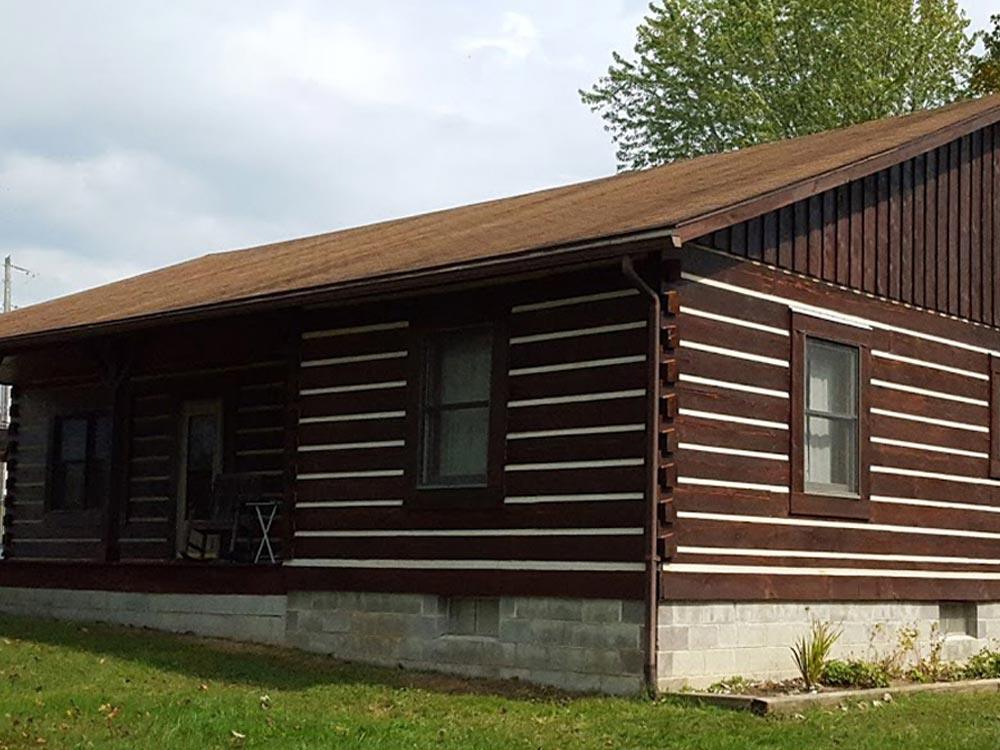
I have meant to send this email for a few weeks as I just wanted to share the before and after photos of a great job completed by Back Country Cabins and their sub contractor Jeff Long.
I have owned my cabin since 2004 which is when I first used Perma-Chink products to stain the cabin and garage. I attended a seminar to see if completing the staining and sealing of the cabin was something I wanted to complete myself or hire someone. I obtained several recommendations of contractors and went with Back Country Cabins. I started the process in May and due to weather and previously scheduled jobs my cabin was finally completed in October and it looks amazing.
Thank you for such a great product and having such reliable contractors to recommend.
Respectfully a Perma-Chink customer for life,
Rebecca Chapple, KY
Cedar Wash™- Ready-to-Use Cleaner for Redwoods, Western Red Cedar, Walnut and Mahogany
The most important step of finishing wood whether it is a log wall, a piece of log siding or a piece of wood furniture is the surface preparation prior to applying a finish system to the wood surface. The reason this topic is so important is that this step or process has an impact on the longevity and durability of the system…
Cedar Wash is designed to remove surface resin oils and high concentrations of water-soluble wood extractives in addition to dirt, grease, grime, pollen, and surface mold and mildew without harming the wood. Wood extractives are compounds present in bark, softwood and heartwood of a tree that contribute to such properties of wood as color, odor, decay and insect resistance. Consequently, these extractives can also discolor paint and finishes (water soluble extractives) as well as create adhesion issues (oil soluble extractives) for many coating types. All wood species contain wood extractives; however, there are a handful of wood species that are characterized as extractive rich woods. This group includes Redwood, Western Red Cedar, Walnut and Mahogany. The second group of wood species that also contains higher levels of wood extractives but not as high as the extractive rich woods include Southern Pine, Douglas Fir, Spruce and Cypress.
- Designed specifically for Western Red Cedar and Redwood (Softwoods) and Walnut and Mahogany (Hardwoods).
- Highly recommended cleaner for Southern Pine, Douglas Fir, Spruce and Cypress.
- Removes resin oils and wood extractives from the surface of the wood that may interfere with adhesion of LIFELINE™ exterior stains or Prelude™ to the wood surface.
- Removes dirt, dust, pollen and other foreign substances from log surfaces.
- Will not harm finishes that are in good condition.
- Contains an aggressive detergent package for efficient cleaning of the wood surface.
- Safe to use on chinking and sealants.
- Easy to use, Ready-to-Use formula.
- Low environmental impact.
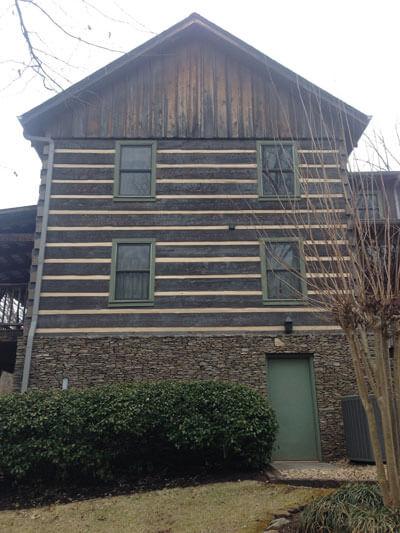

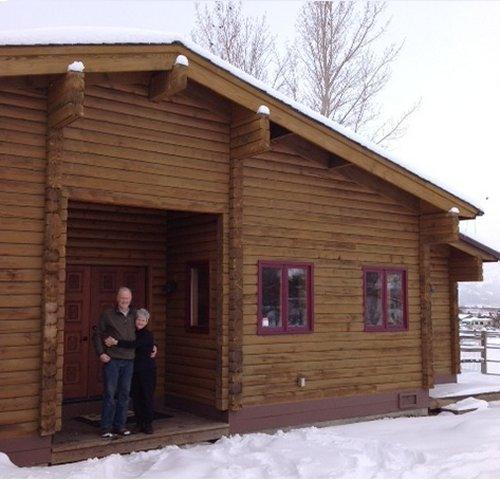
“Hi Kevin, This is wintertime view of the front (north) of our home.
We applied Perma-Chink Products to the south side last October.
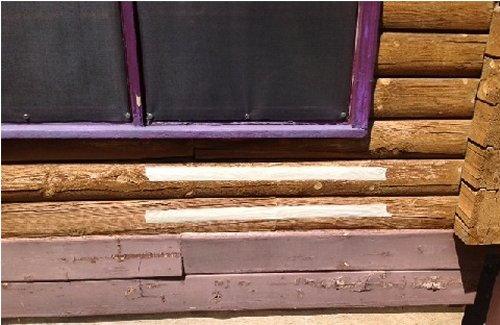
We tested the existing finish before deciding how much work to do.
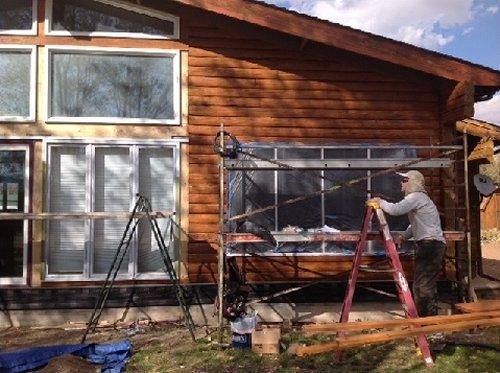
This is the nearly completed south side.
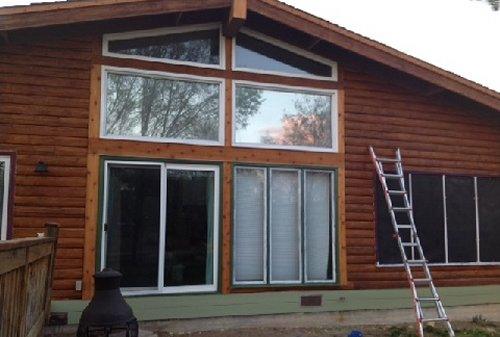
Very satisfying to caulk and seal the logs and to have a durable finish on them. A worthwhile project, thanks to quality materials from Perma-Chink.
Thanks.”
Bob W. in NV
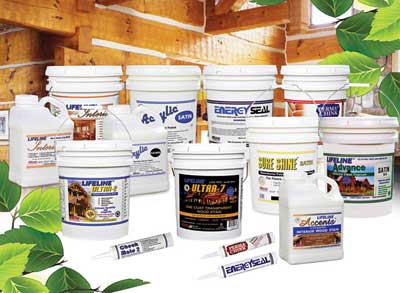
It’s Lifeline™ Season!
PCS manufactured products have a 3-YEAR SHELF-LIFE!
When it comes to protecting log homes with innovative, safe, and trustworthy products, no name is more frequently called to mind than Perma-Chink Systems. Almost for 35 years, Perma-Chink Systems has firmly rooted itself as the premier provider of cutting-edge log home sealants, stains, and maintenance products. There are myriad reasons why log home manufacturers, builders, and homeowners around the world count on Perma-Chink Systems, Inc. Today Perma-Chink Systems made another step forward toward the environment by offering a 3-year shelf life for all manufactured products. Longevity, or shelf life, is the length of time that a commodity may be stored without becoming unfit for use. The shelf life of our products is an equally important environmental factor in order to reduce the potential impact of undesired disposal that could result from a short shelf life. To maximize your Perma-Chink Systems’ products shelf life, follow these important storage tips:
- Keep containers sealed and unopened to minimize exposure to oxygen and oxidation of the product.
- Store away from windows and direct sunlight.
- Store away from heaters or forced air vents.
- Store away from exterior walls, if possible.
- Store in a controlled temperature environment (50° – 70°F, 10° – 21°C)
Shelf life of a full unopened container is three years (no contamination from potential airborne contaminants). Product from opened containers should be repackaged into smaller plastic containers sized to be ‘full’ of product.