Library

All our finish labels and application instructions emphasize the necessity for back-brushing during the application process. What exactly is “back-brushing,” and why is it so important? Back-brushing is the term we use to describe the process of working the finish into the wood and obtaining an intact, uniform film over the entire surface.

Back-brushing is typically used when applying stain with an airless sprayer; however, back-brushing is just as important if the product is manually applied with a brush. Although the directions for most log home stains call for a liberal first coat or flood coat, Lifeline finishes are designed to go on in thin coats, including the first coat. If applied too thick, the long-term performance of Lifeline finishes can be diminished. In other words, more is not necessarily better when it comes to applying Lifeline to your log home.

The first step in the process is to obtain a high-quality brush. A cheap, three-dollar brush from Walmart will not give you satisfactory results. You need a good quality brush like a Purdy or Wooster. For back-brushing logs, use brush preferably three to four inches wide. Using a narrow brush takes longer and may result in visible brush marks. If you plan to hand apply the finish with a brush and pail, you will use the same brush for both the application and the back-brushing.

The objective is to carry the finish to the surface with the brush and then to spread the finish out as far as it will go, making sure to work it into all cracks and crevices, and to uniformly distribute it over the area you are coating. This entails some vigorous back-brushing over the area that has finish applied to it. Lifeline finishes dry fairly quickly, so it’s important to back-brush as you go along and not wait more than a couple of minutes before you back-brush the coat.
We have formulated our Lifeline finishes to be most easily applied using airless spray equipment. There are two methods typically used to apply finishes with an airless sprayer.

The first method is to step back from a wall and use the sprayer to cover a larger area. This works well for a contractor with a crew since a large wall can be coated in a short period of time. This method requires at least two people, one spraying and at least one person back-brushing. When using this technique, back-brushing becomes important since the sprayer puts out lots of small droplets, which result in a lot of small dots of finish, not a uniform film. It takes back-brushing to convert these dots into an intact film, as well as to work the product into any cracks and fissures that are present on the surface.

The other method is to use the airless sprayer to carry the finish to the wall where it can be brushed out. The trick is to work on small areas at a time. Although it takes longer than spraying large areas at a time, a single person can use this technique to finish their entire home. The objective is to apply some finish on a one- to two-foot section of one or two courses of logs, and then brush out what you have applied as far as it will go. You don’t want to apply too much finish, and you need to be quick with the back-brushing to prevent stain from running down the wall. Just remember – A THIN, EVEN COAT is the key.

Stains & Finishes Application Guide

The most important thing that you can do to help maintain the finish of your log or timber home is to keep it clean. An annual washing with Log Wash will help prevent airborne contaminates, dirt, bird droppings, and sunlight from degrading the finish. While nothing can withstand the effects of the environment forever, keeping wood clean and maintained can protect it better and longer. How can keeping the surface clean prevent sunlight from injuring the finish? One of the features of our Lifeline Advance clear topcoats is that they reflect UV radiation.

If the surface is dirty and dull, it reflects less sunlight, and the absorbed UV light will eventually fade the color and gray the wood. So just like automotive finishes, the cleaner you keep your home, the longer the finish will last.

That being said, there will come a time when it may become necessary to do some touch-up work to the topcoat and perhaps the color coat, especially on the south and west walls. The question is, when and where should maintenance coats of finish be applied? The first thing to understand is more is not necessarily better. In other words, if the wall does not need another coat of stain or topcoat, leave it alone.

Advanced Breathability

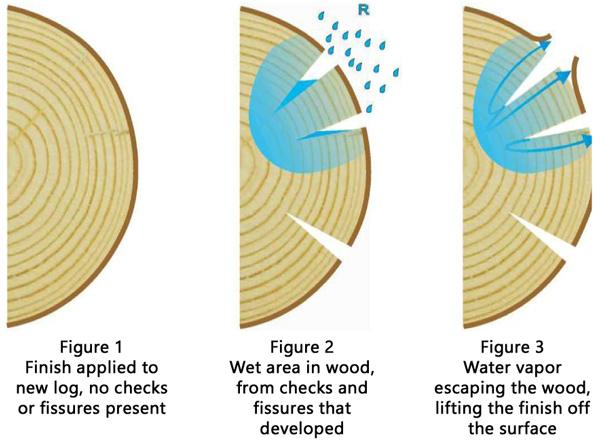
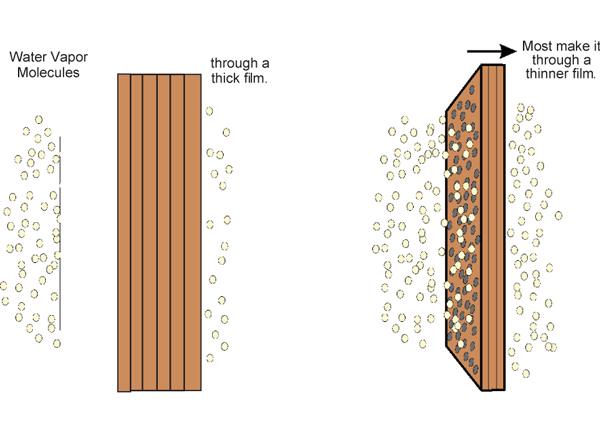
One of the features of Lifeline finishes is the ability to breathe. This allows water vapor to escape from the wood while preventing liquid water from penetrating through the finish. Technically, we call this vapor permeability. If applied at the recommended application rates, one or two coats of stain, depending on the color system chosen from Perma-Chink Systems, and one coats of topcoat maintains enough vapor permeability to allow water that may enter the wood through cracks, checks and fissures to evaporate through the finish. However, each coat of finish that’s applied reduces the vapor permeability of the entire finish system by some percentage. The thicker that a coat is applied, the more it will reduce the vapor permeability. That’s one reason why we always recommend applying thin coats.

How Many Coats Of Stain Are Needed?

Multiple coats of finish can have the same effect as applying coats that are too thick; they can reduce the vapor permeability to the point where the finish can no longer breathe. The consequence of reducing the ability of a breathable finish is the risk of the finish peeling if water gets behind it (see technical tip Peeling Issues). Although occasional maintenance is an important factor in keeping your finish system in good shape, only apply additional coats where they are needed.

So what’s the best way to care for your home and extend the life of your finish system? If, after a washing with Log Wash, you see that the surface has dulled, apply a single coat of Lifeline Advance Gloss or Satin. A dull surface is a sign that the finish has eroded. If it shows signs of weathering or fading color, feel free to apply another coat of Lifeline stain to restore the color and a coat of Advance topcoat.

One or two additional coats will not adversely affect the vapor permeability. But while you are at it, you may be tempted to apply another coat of topcoat on those walls that still look good. Additional coats applied to unweathered walls are not necessary and can eventually lead to problems. If applied correctly, the film thickness of the unweathered walls is still optimal and the application of additional coats can decrease the vapor permeability to a point where peeling could become an issue. In other words, leave it alone.

Ongoing Finish Maintenance

As opposed to other manufactures’ finishes, we do not recommend applying additional coats of stain or topcoat on a yearly schedule. If two coats of stain and one coat of topcoat have already been applied, we recommend applying additional coats only on an “as needed” basis. But we strongly recommend a good cleaning with Log Wash at least once a year to keep your home looking great and extending the longevity of your finish system.

In the early 1980s Rich Dunstan, our founder and company president, had to come up with a company name. Although Perma-Chink Log Home Chinking was the only product manufactured at the time, he chose Perma-Chink Systems, Inc. The name was chosen because he had a vision of developing a full line of products to construct, clean, preserve, seal, finish and maintain the wood components of a log home. Over the years Rich has fulfilled his dream and Perma-Chink Systems, Inc. has become a systems company. No other log home related company offers the broad range of products that we do. However, this large product offering presents a challenge to our own salespeople. We expect them to achieve a high degree of expertise in a wide variety of different product lines. To reach this goal we devote hours of training so that they can knowledgably assist our customers.

Since we are a systems-based company, we have put together a family of products that work together and complement each other. We are often asked questions similar to, is our Energy Seal compatible with ABC Stain or can LIFELINE be used on a home that has been cleaned with XYZ Wood Cleaner? There are hundreds of small regional manufacturers of these products scattered across the country, with full disclosure of ingredients not always given. Since we cannot test all products, the compatibility of these with Perma-Chink products are unknown.

We make every effort to communicate with our customers that we do not sell individual products that can be used indiscriminately with products from other manufacturers. We sell a system of products that work together. When a customer chooses to step outside of our system, problems may develop that can be challenging to solve. Homeowners often understand our system concept better than some applicators/contractors. Over the years, some professionals have found a favorite local manufacturer they prefer for a cleaner, caulk or stain. Then a customer wants him/her to use LIFELINE Ultra-2. The home gets cleaned with XYZ Wood Cleaner, followed by LIFELINE Ultra-2 and Advance, with the home being sealed with AAA caulk. A month or so later we get a call that the wood under the stain has developed dark spots and the caulk is falling out of the checks. The applicator or homeowner comes to us for help because they believe the problem is a result of our product since they have been using the same cleaner and caulk for years.

We often have a difficult time determining the root cause of the failure since we do not know the compatibility of XYZ Wood Cleaner or AAA caulk to our stains. That is why it is important to obtain all your products from Perma-Chink Systems, a systems company, to avoid such problems.

The principle of utilizing our systems is that we have spent many years developing products that work, are safe to use and are compatible with one another. We pride ourselves on being the log home industry leader by constantly making improvements to our finish and sealant systems. We stay abreast of the latest developments in polymer technology and additives. This approach has kept us well ahead of our competitors. We have occasionally been criticized for making changes;however, those changes have resulted in better performance, increased beauty, and easier application of our products.

Another vision that Rich Dunstan had from the beginning of Perma-Chink Systems was to manufacture only products that were friendly to our environment. Yes, we were green when the definition of green was the color of grass. We started making water-based stains when 90% of the log home stains were oil-based. We also invented and introduced the first low toxicity borate-based wood preservative that could be applied to an existing log home. Over the years we have consistently considered the environmental impact of all our products and removed or changed those that did not meet our high environmental standards. This too is a part of our systems concept. Not only do our products work with each other but they also work to protect our environment.

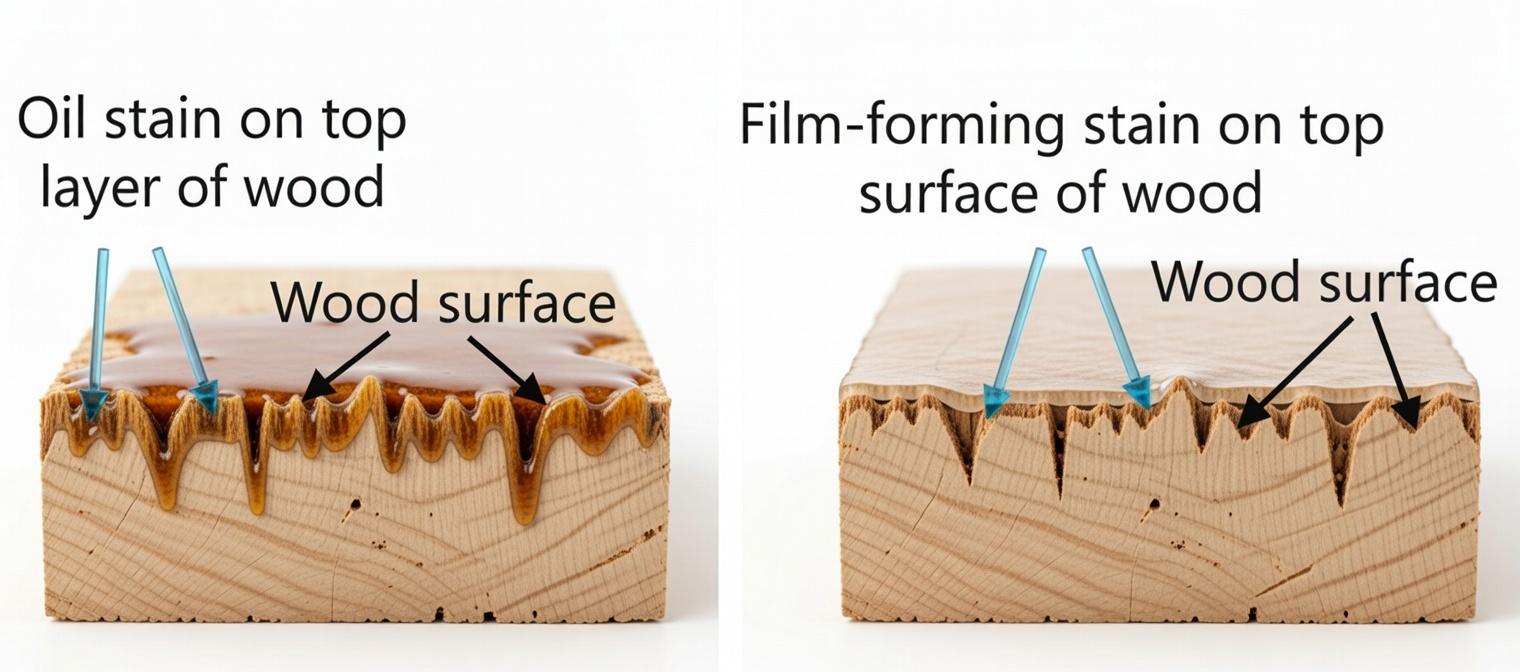
Many people do not understand how film-forming stains work and how they adhere to wood. Much of this misunderstanding relates directly to the term “stain.” In the past, staining wood meant that the wood fibers themselves became impregnated with color and that the color penetrated into the top layer of wood. Even today most oil-based stains work in this manner. Once stained, if the surface is rubbed or scratched, the color of the stain still remains since the solvents carry the colorants into the top layer of wood which make the fibers beneath the surface the color of the stain.

On the other hand, water-based stains like our Lifeline™ products do not actually penetrate into the wood fibers! That’s one reason we try to refer to them as finishes rather than stains. But since the term “stain” has been used for hundreds of years, it’s difficult to change the vernacular that defines the difference between oil-based and water-based products.

When we talk about the penetration of our products, we are referring to their ability to fill the microscopic voids, fissures and pores on the surface of the wood. This enables the film to adhere tightly to the wood’s surface. It’s this property that we call adhesion. However, if the film is scratched or rubbed off of the surface, the original color of the bare wood will be visible.

Why is this important? We’ve had customers call us thinking that the product we shipped them was defective because they were able to rub or scrape the film off and there was no color evident under the film. In their mind, the wood had not “taken the stain.” That’s because they had never worked with a water-based, breathable film stain before, and were used to seeing the results produced by a penetrating oil-based stain.

So how can we best explain how our products work? Most people are familiar with use and behavior of latex paint. It behaves quite similar to a water-based film forming stain in that if it is scraped off of the surface uncolored bare wood becomes visible. Our water-based stains behave in a similar way to latex paint. The benefit is that the protection offered by a film on the surface of the wood is far superior than that provided by a product that soaks into the wood leaving the surface of the wood exposed to the sun and weather.

Microscopic Cross-Section of Wood Surface

The wood surface absorbs an oil-based penetrating stain into the top layer of wood fibers, carrying the pigments along with it. The fibers themselves are thus “stained” with the pigments.

A water-based, film-forming stain sets on top of the wood surface and fills in many of the small cracks and fissures, resulting in a smoother surface; however, the wood fibers themselves retain their original color.

“Which of your products should I use to seal my log home?” is a question often put to us by prospective customers. Why do so many people refer to “sealing” a log home rather than staining or finishing? Nobody talks about sealing siding or trim on a stick built home. They are either stained or painted, yet sealing is the term used by many log home owners. As it relates to log homes the term “sealing” dates back to the early 1900s. Prior to then, most log homes were constructed using heartwood from old growth timber and left bare.

Since heartwood is resistant to insect and decay infestations, and the people who built log homes knew better than to not include porches or leave log ends sticking out beyond the roof line, the best thing for them to do was to leave the logs bare but keep them dry. That’s why so many of them survive to this day.

Sealers

Starting at the end of the 19th century, old growth timber was no longer readily available and people started constructing log homes using second or third growth timber that was mostly sapwood. They also stopped using many of the good construction practices of their ancestors, so problems with bugs and decay began to arise.

At around the same time, the petroleum industry began to develop, for the first time, affordable oil and tar products. Log home owners soon discovered that smearing some of these oil derivatives over their homes helped eliminate some of their insect and decay problems. In their minds, they had “sealed” the logs, and the term has stuck with us to this day. Up to the 1950s, unless the logs were painted, log homes came in two basic colors, black and gray.

So, are any of our Lifeline™ exterior finishes sealers? As the term relates to keeping liquid water from entering the wood, they all are. All of our Lifeline stains (Ultra-7Ultra-2Exterior, and Accents), as well as Prelude™ Clear Primer and Advance™ Topcoat, all act as water repellents to keep the underlying wood dry.

There is a misconception that our pigmented finishes alone do not act as water repellents and it’s the Advance Topcoat that seals the surface. That’s why many people call our Advance Topcoat a sealer, but that’s not an accurate description of the product. All of our stains are excellent water repellents. They may not bead water, but they provide a polymer-film barrier that prevents liquid water from penetrating into the wood.

Stains

Calling our pigmented finishes “stains” can also be a bit confusing. The term itself implies that the wood fibers are “stained” with the colorants contained in the products. However, in the case of film-forming, water-based finishes, the wood fibers are not impregnated with the colorants like they are when penetrating oil stains are used. If wood is painted with a latex paint, no one expects the paint to impregnate the underlying wood. So if you believe that your wood is not “taking” our Lifeline stain, it’s important to understand that our finishes behave more like latex paints than penetrating oil-based stains.

Since most people are comfortable with “stain” as a product that alters the color of the wood and still allows the grain to show, using “stain” is more accessible for customers (as well as when searching on the Internet). 

Topcoats

Top coats are clear finishes that protect and cover the pigmented finish on logs, timbers, and other wood features. One of the most frequently asked questions we receive about our Advance Topcoats is why isn’t it included with the stain. The answer is that if we did, it would no longer be a topcoat. Topcoats play a specific role in protecting any finish system.

Take car finishes for example. The pigmented paint provides the color and helps protect the metal from corrosion. It is formulated to adhere to the primer and retain its color. The car’s clear topcoat is designed to protect the color coat from abrasion, dirt and sunlight and the only thing it has to adhere to is the color coat. Our Advance Topcoats play essentially the same role, to protect the color coats from the weather, sunlight, and dirt.

Although our stains adhere to bare wood, previously applied stains, and existing topcoats, it is not necessary for Advance to adhere to bare wood since it clearly states on the label that it’s to be applied only over an existing finish.

Although most topcoats on the market are just unpigmented versions of stains, Advance is specifically designed as a high performing topcoat with a unique set of characteristics that have yet to be duplicated by anyone else in our industry. One of the reasons Lifeline Advance outperforms all other topcoats is that it is designed for a very specific purpose and should never be applied to bare wood.

Before you apply coatings to interior surfaces, always thoroughly wash them with a recommended cleaning solution. Log Wash is made for this purpose and should be used as follows:

Mix 1/2 cup of Log Wash Concentrate in a pail with one gallon of warm water. Apply the Log Wash solution to the wall with a rag or sponge. Allow the solution to remain on the wall, keeping it wet for at least 10-15 minutes. Using a clean rag or sponge and a pail of clean water, wipe the Log Wash solution off of the surface. Frequently rinse the sponge or rag in the pail of water and frequently exchange the water in the pail with clean water.

To make sure you have the correct amount of finish, read this Tech Tip on determining square footage, as log homes are built in various layouts which all affect square footage. 

 Applying Interior Finishes

1. Stir the containers of LIFELINE finishes thoroughly before starting. Remember that even clear coats require stirring to blend different ingredients within the container. Use a drill-powered paint agitator for 5 minutes on a newly opened container to completely mix settled ingredients.

2. NOTE: Sure Shine should be hand-stirred, using a paddle or a paint stick to avoid entraining air in the liquid.

3. When using multiple containers of colored finishes, they should be ‘boxed’ (see ‘Mixing and Boxing Stains & Topcoats‘). Do this by thoroughly stirring LIFELINE in its original container and then combining contents of different containers together in a separate container.

4. To avoid leaning ladders against freshly applied LIFELINE, it is best to start at the top of the wall. Place ladder end on unfinished logs below your work line.

5. Wipe up runs and drips immediately. They will come off best using a wet rag.

6. When you take a break, submerge the sprayer tip in water to prevent clogging with partially-dried LIFELINE.

7. Avoid lap marks. Work on one or two courses of logs at a time and never stop in the middle of a log. Work to natural break points such as corners, window edges, butt ends of logs, or other natural break points.

8. Continue application by running a wet edge until a break point is reached. As you approach a break point, feather your wet edge and continue working the LIFELINE from your brush until the product runs out. Start spray pattern away from the break point and finish back-brushing to the break.

9. Apply LIFELINE in thin coats. If it runs down the wall, you are applying too much. OBSERVE CORRECT COVERAGE RATES as listed on label.

Can Lifeline™ Interior stains be used to finish interior floors? Technically the answer to this question is yes, but we rarely recommend them unless whoever is going to be finishing the floor fully understands the characteristics of water-based, transparent stains and knows how to apply them.

Professional floor finishers have been using oil-based stains ever since it became fashionable to add some color to flooring. The application techniques and procedures used for applying an oil-based floor stain has not changed for decades, so most everyone selling or applying floor finishes will give a standard set of instructions to anyone planning to finish their own floors. However, if these directions are used when applying a water-based stain, the results will be unsatisfactory.

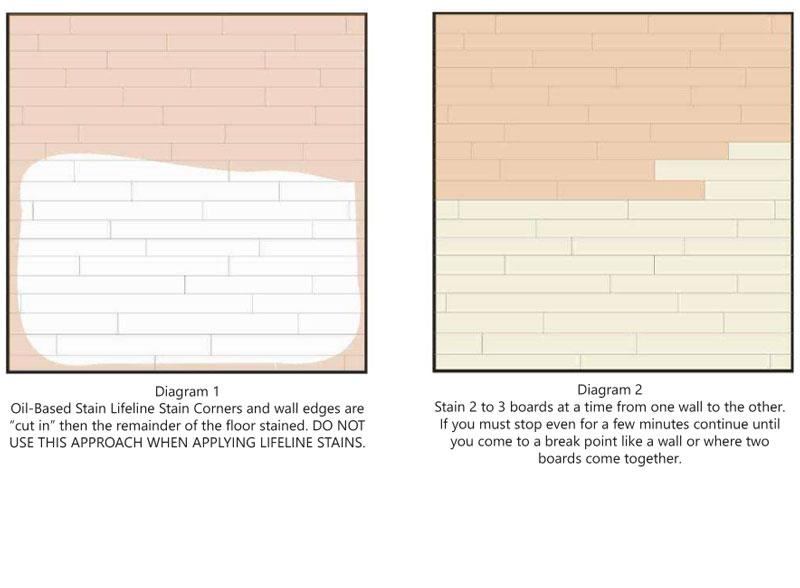
Once the floors are sanded and cleaned, a professional floor finisher using an oil-based stain will usually “cut in” around the baseboards and corners with a brush, rag, or pad, then apply the stain to the remainder of the floor [see Diagram 1].

Since oil-based stains take a fairly long time to dry, the interface between the “cut in” areas and the center area can be feathered together, so it becomes impossible to see any differences in color. Water-based stains dry very quickly, so it’s impossible to feather in any previously stained areas without creating lap marks. However, there are some distinct advantages for using a Lifeline water-based stain. These advantages include little or no odor, soap and water clean-up, quick dry time, and environmental friendliness.

If you choose to use a Lifeline Interior stain for your floor, here is the way to apply it:

1. Sand the floor as usual.

2. Vacuum, then wipe the floor with a damp cloth. Keep rinsing the cloth so that it does not accumulate too much sanding dust. It will raise the grain a bit, but that’s okay. The water-based Lifeline stain will end up raising the grain anyway, and the slight roughness will be dealt with later in the finishing process.

3. Once the floor is dry, apply one light coat of Lifeline Prelude™ clear wood primer with a brush or pad. This will seal the surface and help prevent any blotchiness due to varying porosity from the sanding process. Don’t worry about lap marks or surface roughness at this stage.

4. After Lifeline Prelude dries, apply the first coat of Lifeline stain. This is where care must be taken to avoid lap marks. Start at one corner of the floor and work on two or three boards at a time all the way across the floor. If you must stop before you get to the other side, be sure to continue to where one board ends and another begins [see Diagram 2]. Apply Lifeline in a thin coat and back-brush as you proceed.

5. When the floor dries you can decide if you want to apply another color coat. It’s not necessary and depends on how much color you want to obtain. Do not sand.

6. Once you have attained the desired color and the floor is dry, you can begin applying PCS Clear Shield to the floor. The technique for applying PCS Clear Shield is different than applying the Lifeline Prelude or Lifeline stain, so be sure to read the Applying PCS Clear Shield Technical Tip before you start.

7. Now that you have the first coat of PCS Clear Shield on the floor, and it’s good and dry, you can give the floor a light sanding using fine sandpaper (180 grit or higher) to remove any surface imperfections. Do not sand too hard or you’ll end up removing the finish. Once sanded, remove any dust with a damp cloth. Sanding between subsequent coats will not be necessary. Floors usually take two to four coats of PCS Clear Shield to assure maximum durability and desired uniform appearance.

8. Although you can usually walk on the finished floor within a few hours, it’s best to wait 72 hours before replacing any furniture or subjecting the floor to heavy traffic.

What about applying PCS Clear Shield over a newly applied oil-based stain? There is no problem with this as long as the oil-based stain is good and dry. Typically, we recommend waiting a week or two, but it really depends on the temperature and humidity. It is best to check with the manufacturer of the oil-based stain to see what drying time they recommend before applying a water-based polyurethane clear coat.

“My log home is around 2000 square feet. How much stain will I need?”

Often that’s all the information a customer has available when they first call Perma-Chink Systems. When people talk about the square footage of their home, they are usually referring to the floor area that may or may not include a garage. But does this number give us enough information to make an estimate of how much stain and topcoat will be required to finish a home?

Look at the outlines of three log homes with approximately 2000 square feet of floor area at the bottom of this page. Home A is just about square, Home B is long and narrow and Home C has two extensions on the ends. Even though the floor areas of these homes are nearly the same, the perimeters of the homes are significantly different and the perimeter is a significant factor in determining total exterior wall surface area.

For example, if we have flat log walls that are 12 feet high and ignore window and door openings, the exterior wood surface area of Home A is 2136 square feet whereas the exterior wood surface area of Home C is 2880 square feet, a difference of 35%. That’s why knowing the floor area of a home does not really help us determine the amount of finish required to stain a home.

So how can you determine the square footage of your exterior log walls?

It’s easier to work up the numbers one wall at a time then add them together. Start by measuring the length of the wall with a tape measure. Then either measure the height, or estimate it by counting the number of log courses and multiplying the number of courses by the diameter or height of the logs. Just remember that the diameter, or height, is in inches, so you will need to convert inches into feet. For example, if the logs are 6 inch high logs, they are 6/12, or 0.50 feet, in height; and if they are 10 inch logs they are 10/12, or 0.83 feet, in height.

So if we have a wall that is 25 feet long and has 16 courses of 10 inch logs the calculation is:
25 ft. x 16 courses x 0.83 ft. = 332 square feet.

Now this assumes the wall is flat, but what if the logs are round? A rule of thumb is to add 25% to the square footage of a wall to compensate for the increased surface area created by the curvature of the logs. So in the above example, if the logs are round you would multiply the 332 square feet by 1.25 resulting in 415 square feet of wood surface area.

What about log siding?

Round log siding has a curvature too but it’s typically not as pronounced as full logs. In this case a multiplying factor of 1.15 will work. Gable ends appear to present a challenge in calculating their square footage, but if you take their height from the base to the peak and the width end to end, multiply them together, then divide the number by 2, and you’ll come pretty close.

Estimating the square footage of exterior wood surfaces is not easy and mistakes are commonplace. Just remember a few tips: never multiply feet by inches, measure everything twice, and have someone else check your calculations.

We usually recommend not to deduct door and window openings (unless the windows account for over 20% of the wall area) or chink joints. It’s always best to stain the log edges of a chink joint before the joint is chinked to protect the wood from water infiltration. The last thing is to add at least 10% extra product to your order. It’s better to have some material left over than it is to run out near the end of a job.

Here is a comparison between three homes with similar floor square footage. You can see from the calculations how the footprint of your home can affect the surface area of your home.

Lifeline Prelude is a clear wood sealer and primer for surfaces that have been media blasted. Lifeline Prelude is enhanced with UV Boost for maximum protection against graying due to ultraviolet light exposure.

Over the past few years media blasting has become a popular tool for removing old finishes in preparation for applying a new coat of stain. However, media blasting significantly increases the porosity of the wood, thus allowing it to absorb much more stain than those wood surfaces that have been chemically stripped, sanded, or pressure washed.

This high absorption results in a darker final stain color than that typically reflected by a color chart. In addition, wood is not uniform and media blasting often emphasizes the differences in wood grain absorption, even on a single log. This results in streaks and blotches due to varying amount of stain absorbed by different areas of the wood. Lifeline Prelude solves many of the potential problems created by media blasting.

One coat of Prelude primer fills the pores of the wood and provides a uniform surface film in preparation for the application of a pigmented stain. However, it should be noted that Lifeline Prelude is a wood sealer/primer and is not suitable as a clear, final finish!

Recommendations for the use of Prelude:

1. After a home has been media blasted.

2. If a home is aggressively pressure washed to the point where the surface is feathered and the porosity of the wood varies from area to area.

3. On wood where the surface has been unevenly sanded.

4. On rough cut siding before the application of the color coat(s).

5. If a section of a wall has been repaired or replaced and the new sections don’t match the surface characteristics of the old.

6. Whenever an older home (more than 80 years old) is going to be restored. Once the surface of old wood is cleaned of grayed wood it typically takes on the porosity characteristics of a blasted surface.

7. Whenever you want to use only clear coats on interior surfaces. Although Lifeline Interior Clear can be used, the use of Prelude as the first sealing coat is a better deal, since it already contains UV Boost. Once Lifeline Prelude dries, Acrylic Gloss or Satin or PCS Clear Shield Gloss or Matte can be applied over it.

8. Whenever a home is completed but may remain without an exterior finish for many months, a coat of Prelude will help prevent surface graying and make it easier to clean when it comes time to stain. Adding a dose of Stay Clean to the Prelude will help also prevent the growth of surface mold and mildew.

For use exclusively with Lifeline wood finishes.

With so many different choices on the market for wood restoration and cleaning products, it can be confusing trying to decide just what to use. Unfortunately, when it comes to cleaning or restoring wood, there is no “one size fits all” approach. Each unique situation has a chemical solution that best solves that problem. Perma-Chink Systems understands these challenges and we have developed specific products to address each situation.

We offer a wide range of cleaning and restoration products that are designed to be fully compatible with our other wood care products. Our name says it all – Perma-Chink Systems. If you choose to stay within the system, you can have confidence in a fantastic outcome.

It is difficult to determine exactly what is in a typical store brand of cleaner. Many of these cleaners, conditioners and brighteners may contain ingredients that are not compatible with our products. Some brands of wood cleaners may leave residues that prevent adhesion of our stains – even after considerable rinsing. Many of these cleaners may even damage the wood to the extent that adhesion of our stains may be a serious problem.

Furthermore, a number of these cleaners can even cause unsightly wood discolorations. But do not worry, stop playing the guessing game. For over forty years now, Perma-Chink Systems has been working towards creating and testing products that work together for your success! Let us take a closer look at a few of them.

Log & Timber Home Wood Cleaners

Our wood cleaner Log Wash, was originally developed to clean coated wood surfaces by removing mold, dirt, oils, and other surface contaminants without damaging the existing finish. Over time, it was discovered that Log Wash is also effective for cleaning bare wood.

Wood chemistry is complex. Naturally occurring compounds within wood help protect it from disease and decay, but some of these extracts and resin oils can surface over time and cause discoloration that may be undesirable in appearance.

Wood tannins are one class of naturally occurring chemicals that can cause discoloration when they react, or complex, with iron, forming dark stains on the surface of the wood. Log Wash contains phosphoric acid, which also reacts with iron to form compounds such as iron(II) phosphate or iron(III) phosphate. These compounds effectively compete with the wood’s natural tannins for available iron. By reducing the amount of free iron that can react with tannins, Log Wash helps prevent the formation of dark, ink‑like discolorations on the wood surface.

Using Log Wash not only cleans the surface but also helps stabilize a very complex system – the wood itself. Many commercially available cleaners are high in pH, such as caustic cleaners, which can damage wood coatings by softening them. When these cleaners are rinsed or pressure‑washed off, the softened coating can be removed along with them.

When used according to label instructions, Log Wash maintains a slightly acidic pH range, which closely matches wood’s natural chemistry. By keeping the pH balanced where wood is most stable, Log Wash helps avoid undesirable chemical reactions that are more likely to occur under highly alkaline conditions.

Wood is a unique, natural substrate that appeals to us due to its beauty and natural characteristics. Are all wood species the same in chemical composition? The obvious answer is no they are not.

Although all wood contains cellulose and hemicellulose, it is the wood extractives and resin oils that contribute in large part to the differentiation of one species from another. In addressing these differences it brings us to our next wood cleaning product: Cedar Wash. This product was developed to deal with certain species of wood that naturally contain very high levels of extractives and resin oils. The presence of these extractives can cause several problems including discoloration, stains and adhesion problems with a coating. Wood that falls into this category of “extractive-rich” includes Redwood, Western Red Cedar, Walnut and Mahogany. A second class of wood that contains high levels of extractives but not as high as the “extractive-rich” includes Southern Pine, Douglas Fir, Spruce and Cypress.

Cedar Wash is a Ready-To-Use formula designed to effectively remove resin oils and wood extractives from the surface of wood and it will not harm finishes that are in good condition. In addition, the product is safe to use on chinking and sealants and has a low environmental impact due to its safe chemical composition.

Dealing With Dark, Vertical Streaks

What if my wood already has metallic iron tannate stains what can I do about them?

First, you need to be certain that the discoloration is from iron tannates. You can perform a simple test with a Q-tip dipped in diluted 3-to-1 bleach solution. Apply this to a small test area and if the dark color disappears, your color problems are most likely from surface mold.

In contrast, iron stains will also have the appearance of streak marks running down a wall in a vertical direction and will not go away with the Q-tip test. Oxcon, which contains Oxalic Acid, was developed to help brighten wood with dark discolorations due to iron stain. Ferric Iron, which is dark in color, will react with Oxalic Acid to form Ferrous Iron which is colorless. The key to all this working properly is good rinsing afterward. If the oxalic acid is not rinsed well, it can leave surface crystals that can interfere with adhesion.

Brighten Bare Wood Back to Original Color

Bare wood when left exposed to the elements will weather. What do we mean by weather? Wood is continually going through changes due to sunlight, water, mechanical forces and heat. Each of these can present problems, but sunlight does considerable damage to the surface of the wood due to a process called photooxidation. In this process lignin, which provides support structure in the cell wall, is broken down and degraded, turning the wood grey in appearance.

After this damage has occurred it would be unwise to stain or paint on the surface of the damaged wood. Ask yourself would you apply paint to an old rusty metal pole and expect it to stay adhered for a long time? Of course not. In the same way, the compromised wood surface must first be removed through mechanical and chemical means before applying a coating to the surface. The best product to deal with this problem is called Wood Renew, and when dissolved in water produces hydrogen peroxide.

This, along with additional highly effective cleaning agents, work together to remove resin oils, dirt and disinfect the wood. A pressure washer is used to help mechanically remove the damaged layer of wood leaving behind a bare, clean, and newly restored surface to apply a coating. The appearance of the wood changes from a dark gray to a freshly milled yellow color. It is truly amazing to see the difference this process can have on the wood. Surface mold and spores, dirt and damaged wood fibers are all removed in this process. We are cleaning and restoring wood back to its original, bright clean form.

Finish Removal

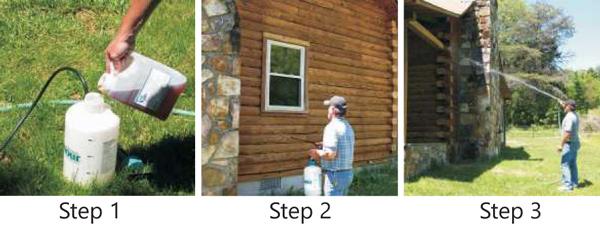
If you have an existing finish that you need removed, we have two chemical options for you. The first is called S-100. It uses a proprietary, environmentally safe ingredient to help soften the existing film prior to removal. S-100 forms a gel on the surface of the film, allowing it to have maximum contact time with the surface. The surface is then rinsed using a pressure washer to remove the film and S-100 from the surface.

Our second option, called Strip It®, uses a highly effective but low toxicity active ingredient called Benzyl Alcohol. Like the S-100, this product also acts on the surface to soften the film and is removed with the assistance of a pressure washer.

stripit-finish-remover

Both S-100 and Strip It are water-based products that are environmentally friendly and safe, as opposed to hazardous solvent-based products like methylene chloride, methanol, and petroleum solvents. Strip It is practically odor free, S-100 has a citrus odor, and both are non-flammable and biodegradable.

Rinse Completely

Finally, there is one critical procedural step shared by all cleaners and wood restoration products: proper rinsing. Every product used must be thoroughly rinsed from the wood surface.

You may wonder, “How do I know when I’ve rinsed enough?” Perma‑Chink Systems offers a simple solution. We provide pH strips that allow you to test both the rinse water and the wood surface. We strongly recommend using pH strips to confirm that the substrate has been rinsed back to a near‑neutral pH range of 6.5 to 7.5.

Inadequate rinsing can lead to a variety of problems, many of which are completely avoidable. Taking the time to rinse properly ensures better performance of subsequent products and long‑term success of the restoration.

Final Notes

At Perma‑Chink Systems, we’ve worked tirelessly to develop high‑quality log and timber home products that support you through every step of the restoration and maintenance process, while always prioritizing safety and environmental stewardship. For best results, we strongly recommend following all label instructions when using our products.

In addition, we’ve created a wide range of Technical Tips to help guide you along the way. These include resources such as our Cleaning Guidelines, Finish Removers Application, and many others designed to help you understand and resolve common challenges.

If you need further assistance, our product specialists are always available at 1‑800‑548‑3554 to answer your questions. We hope this information helps you better understand the purpose and proper use of our cleaning and restoration products – and supports the long‑term success of your project.

If a home has been media blasted, is it really necessary to wash down the wood with a Log Wash™ solution before it is stained? We believe it is and here’s why. If corncob grit or walnut shells are used, and you take a close look at a blasted wood surface, you will find lots of particles embedded in the wood. Along with the particles are invisible mold spores that can germinate and feed on these biodegradable media sources.

To prevent mold spots from developing under the stain, these mold spores need to be removed, preferably by washing the surface with a solution of Log Wash (2 cups per gallon of clean water). Even if glass, dry ice, or other types of blasting media is used, we still recommend washing down the blasted surface to remove any remaining foreign matter substances that may be adhering to, or embedded within, the wood. Blowing high pressure air on the wall will not totally remove all of the dust and old finish residue; and without actually washing the surface, you run the risk of compromising the adhesion of the new finish.

On the other hand, most chemical strippers and cleaners do a good job eliminating mold spores and dust particles which is why it may not be necessary to use Log Wash if the home is going to be stained within a few days stripping or cleaning. However, if the stain application is delayed more than seven days after the wall has been chemically cleaned, an application of a two cups per gallon Log Wash solution should be made, rinsed, and the wood allowed to dry before the stain is applied. It only takes a few days for enough mold spores, pollen, and dirt to accumulate on bare wood to create a problem.

We always recommend thorough cleaning and preparation procedure because careful preparation is the best way to help prevent unsightly fungal growth under our transparent finishes, and to ensure the best adhesion and longevity of our exterior stain and topcoat systems.

CHEMIST’S CORNER: Can All Wood Species Be Prepared the Same Way, Using the Same Cleaning Products?

The obvious answer to this question is NO. Although all wood species contain many of the same components – including cellulose and hemicellulose and minor amounts of extraneous materials – it is the wood extractives that differentiate wood species from one another.

Understanding the Bleeding of Wood Extractives.

Wood extractives are compounds present in the softwood and heartwood of a tree that contribute to such properties like color, odor, decay and insect resistance, density, and flammability. When used for log homes, naturally occurring extractives in the wood can migrate to the surface and discolor paint and finishes (water soluble extractives) as well as create adhesion issues (oil soluble extractives) for many coating types.

The organic components of the extraneous materials are referred to as extractives because they can be removed by extraction with solvents without altering the cellulose/lignin structure of the wood. Extractives include tannins and other polyphenolics, coloring matter, essential oils, fats, resins, waxes, gums, and starch. Depending upon such factors as species and growing conditions, the total extractive content of wood substance may range from less than 1% to 30% in extreme cases.

Wood Species and the Level of Extractives

All wood species contain wood extractives; however, there are a handful of wood species that are characterized as extractive-rich woods. This group includes Redwood, Western Red Cedar, Walnut and Mahogany. The second group of wood species that also contains higher levels of wood extractives but less than extractive-rich woods include Southern Pine, Douglas Fir, Spruce and Cypress.

The percentage of extractives in trees is generally low, but a high concentration is found in knots and heartwood of the tree. Knot bleeding can occur when a knot contains an excessive number of extractives. In these cases, the extractives consist mainly of rosin, fats and turpentine, and these extraneous materials can make up as much as 50% of the knot by weight. The ratio of extractives can change with the season and weather (if the tree is stressed).

Extractives Affecting Wood Color

Staining or discoloration of wood may result from chemical processes that convert originally colorless or light-colored extractives into intensely colored products. Most of the “chemical stains” result from oxidation of certain wood extractives during air seasoning or kiln drying. Some resins can bleed out of the wood, as seen in pine wood. Sometimes the extractive can react with foreign material.

Using Cedar Wash for High-Extractive Wood Species

Cedar Wash is a wood cleaner with a high pH solution, which can dissolve, soften, loosen, or react with different types of extractives found in extractive-rich woods used in log homes. If a chemical is soluble in a liquid, it is easier to remove than a chemical that is only softened by that liquid. Being soluble is preferred as this means the particles are broken down to become so tiny we can no longer see them. Cedar Wash is designed to remove surface resin oils and high concentrations of water-soluble wood extractives such as sugar and protoplasm, in addition to dirt, grease, grime, pollen, and surface mold and mildew without harming the wood.

Cedar Wash was developed by Perma-Chink Systems as a Ready-to-Use cleaner specifically formulated for preparing the surface of wood species that contain high levels of wood extractives and resin oils. It is also safe for chinking and sealants.

  • Easy to use, Ready-to-Use formula.
  • Low environmental impact
  • Designed specifically for Western Red Cedar, Redwood (Softwoods), Walnut, and Mahogany (Hardwoods)
  • Removes resin oils and wood extractives from the surface of the wood