
Blog
Log Home Restoration with Major Log Repair
When you look at these pictures, you probably think to yourself: how is it possible to repair these logs?
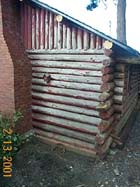
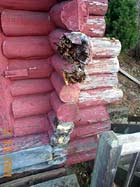
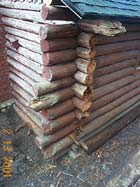
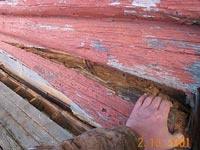
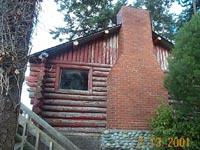
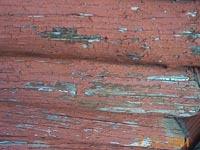
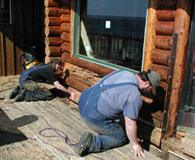
Chris Hastings, the second generation of log home restorers knew the answers. The major problem was in the design of the house. The house was designed improperly for the building site. The extensive damage on the lower third of the wall on the exposed side of the house was due to the insufficient overhangs and water damage.
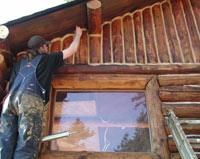
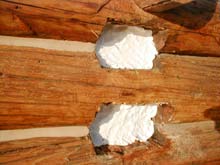
What kind of work will bring this house back to life? The first step for this project is exterior media blasting, followed by log repairs, washing and brightening the exterior wood surface, applying borates to preserve the logs and interior and exterior chinking. Exterior visible water damage prompted Chris to cut away the outer half of this log which shows major water damage in the log’s core.
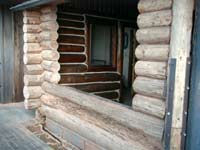
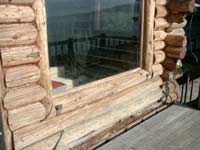
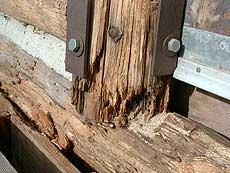
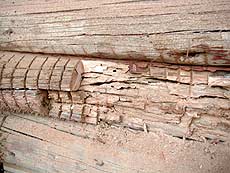
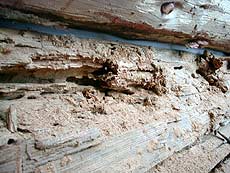
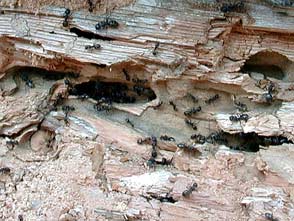
You can see how carpenter ants ( which are attracted to high moisture content in wood) have the ability to destroy logs in your log home, often in a short period of time, and in this case, causing major structural damage. Prevention of water intrusion by using a high quality log home finish (Lifeline Ultra–7 with Lifeline Advance) and sealants (Perma-Chink and/or Check Mate 2) would have helped eliminate this costly problem.
Following the use of the finish removal system, that stripped off previously applied paint and UV discoloration, you can see (below) how a treatment of Oxcon further brightens the logs without damaging wood fibers. Following a rinsing of the logs with water, your home is now ready for the borate treatment.
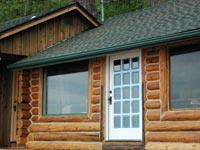
After a borate treatment was completed, M-Balm was injected (squeeze bottle) within the log cavity. M-Balm not only hardens the wood, but also stops any further spreading of wood rot. Following the borate treatment and Oxcon to brighten the wood, Chris installed one window to the left for better appearance of this home. Now that house is protected against wood-destroying insects, an application of stain and topcoat will not only enhance your home’s aesthetic appeal, but will offer protection as well.
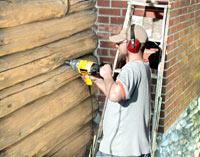
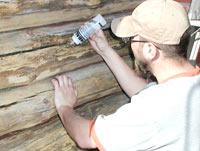
The semi-transparent stain will protect your wood from the damaging effects of UV exposure. We recommend one coat of Lifeline Advance (clear coat finish, similar technology used in the automobile industry) over the stain color for protection and extending the life of the pigments in the stain. It also will give a maximum protection against water penetration.
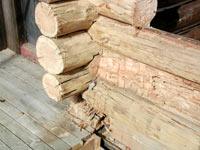
The repair of water-damaged log ends will bring us to the final step: applying Perma-Chink between all logs to further protect against air and water intrusion. Prior to the last step of chinking the featured structure, Chris Hastings and his crew replace the outer half of the structurally damaged lower log with a fresh, sound log section.
The final step in the restoration process is to chink all seams (both vertical and horizontal). Perma-Chink chinking that permanently bonds to wood will retain its elastic features in all climates and will provide year round energy efficient comfort.



Why do my choices regarding surface prep, stain, and color matter?
When it comes to choosing a finish system for your log home exterior there are many factors to consider and depending on what choices you make it will have a significant impact on the longevity of the finish system. For example, some of these choices include surface preparation, type of stain, and color choice. Let us take a closer look at each one of these factors and discover how they each contribute to a systems performance.
Surface Preparation
First, surface preparation is often overlooked, not taken seriously, or even dismissed entirely. At Perma-Chink Systems we have learned through many years of testing and experience that this is an important step and forms the foundation for a successful finish system.
Does the surface of the wood have mold, dirt, discoloration, existing finishes, metal contaminants or greyed weathering? All these wood conditions will likely lead to problems with your finish system if left unaddressed. Perma-Chink Systems offers a full line of wood restoration and cleaning products and literature to deal effectively with each of these wood conditions.
Increased wood surface porosity is also important and to achieve best results, we recommend sanding your wood with 60 grit sandpaper. This allows for improved mechanical adhesion of the stain with the wood fibers and increases overall performance of the system as well as color uniformity. The overall color development will be much darker than on un-sanded wood. Nevertheless, the protection of the wood surface is increased substantially. Staining on smooth/un-sanded wood can look splotchy due to the reduced porosity and unevenness of the wood. As a result, not much stain goes on the wall and the performance is reduced accordingly.
If, however, surface preparation is skipped or done improperly prior to an application of stain, it will impact the appearance and longevity of the final system. Some of the likely outcomes such as peeling and early discoloration and unhappy homeowners are the usual result.
Choosing the Right Stain
The type of stain you choose also will impact performance. For all horizontal surfaces it is more advantageous to go with a penetrating type of stain such as our Deck Defense™. If you want to coat both horizontal and vertical surfaces another penetrating flat stain such as our Log and Timber Defense™ is an excellent choice. For all vertical surfaces film forming stains such as Lifeline Ultra 7™, Lifeline Ultra 2™ or Lifeline Exterior™ are your choices. For long lasting color fastness and protection on vertical surfaces the best option is our all-acrylic Lifeline Ultra 7.
Two broad categories for stain type are oil and water-based stains. What distinguishes these two types from each other? The advantages of oils are ease of application, extended drying time and initial high gloss appearance. The disadvantages of oil types are, more hazardous to work with due to dangerous flammable solvents as a primary ingredient, the gloss appearance dulls relativity quickly with exposure and due to its high solid content is less breathable and can chip and peel more easily than a water-based stain. Clean up of oils requires dangerous paint thinner solvents and is arguably more difficult. All our water-based stains are non-hazardous and easy soap and water cleanup as well as breathable making them less susceptible to peeling and chipping.
Choosing the Right Colors
Finally, color strongly influences the performance of any finish system. Our stains are designed to be semi-transparent. This allows the observer to more easily see the unique features of the wood such as grain and texture. However, by their very nature transparent type finishes do not offer the kind of protection afforded opaque systems such as paint. In many of our exterior formulations we use Transparent Oxide type pigments. These pigment types still allow light to pass through so that you can see the grain while at the same time providing a high level of protection from the sun. In addition, we avoid using organic type colorants that are not as colorfast as oxide-based colorants. In general, the darker tone colors will provide more protection and longevity for your home while lighter honey tone colors offer reduced protection. Nevertheless, at Perma-Chink we understand that color is a very personal preference and we all cannot agree on exactly what we would like our home to look like. Perma-Chink offers a broad range of color choices to meet our customers’ expectations and desires when it comes to color. Color formulation have been carefully evaluated for color longevity. Pigment loading levels have been formulated to give the greatest protection possible while at the same time providing color choices that meet our customers’ needs.
Some additional choices such as how many coats of stain, topcoat or no topcoat and surface porosity are also important factors. In general, two coats of Lifeline stain are better than one. It helps to even the color out and provides increased protection of the wood. Having a clear topcoat, such as our Lifeline Advance™, is also a great benefit. This helps keep the system sealed, dirt pickup is greatly reduced, performance of the system is increased, and it provides a great look to the final product.
Contact Us for Assistance
As a log homeowner you have many important decisions to make when it comes to the care and maintenance of your home. At Perma-Chink Systems we have spent the last 40 years developing solutions to help meet your needs. Your choices as well as ours do matter and will make a difference. Let us work together to keep your log home looking great well into the future. For more information about our products please give us a call at 1-800-548-3554 and tell us what your needs are. You can also visit our website at www.permachink.com where you can find more information and order our products directly.
Dear Terry,
I cannot thank you enough for your support with my staining challenge! You clearly went above and beyond to resolve my issue, and I truly appreciate it!
As first time users of your stain for our new log home build, we love the Perma-Chink Systems line of products and will be loyal customers! Stain colors as advertised and displayed in your samples, and the customer service, such as yourself, as well as the speedy arrival of our products is why you have such a solid reputation!
Out of a five star rating, you have earned six stars with us!
Thank you, again!
Sincerely,
Kathy N.
I would like to express my extreme satisfaction with my customer service experience at Perma-Chink. My service representatives, Joanne and Stephanie, were very helpful, polite and professional and worked hard to resolve my issue.
I have used Perma-Chink for all my staining needs and with a log home there are many! Their representatives are knowledgeable and know well the products they sell and guide their customers to what they need and explain how to use them.
When my home needs to be re-stained in a couple years, I will, without hesitation, purchase stain and Log Wash, brushes, etc., from them again.
Thank you so much all!
Nancy K.
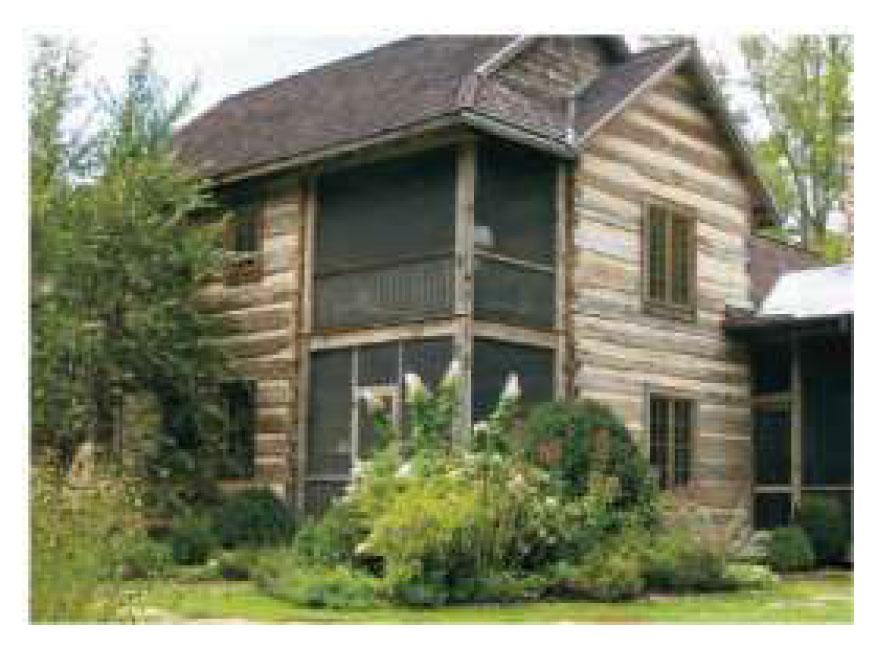
Centipedes, millipedes, pill bugs, roaches, crickets, ants, beetles, spiders, wasps, squirrels, opossums, raccoons, bats and mice are just some of the pests that manage to find their way into homes. It’s just about impossible to keep all of them from getting in, but there are several things that you can do to significantly reduce the number of pests that make it inside your home. Most have to do with blocking the ways they can enter. Furthermore, there are also some things you can do outside to make your home less attractive to pest invaders.
Landscaping
Most pests including rodents and insects like shaded, moist environments. All of the plants and shrubs surrounding your home may appeal to you but they also appeal to numerous pests.
It’s not that you have to cut them down and get rid of them, just move or trim them away from your foundation or log walls. What you need is a two foot clear space between the shrubs and your walls and foundation.
Once you move and/or trim them, you need to put some type of cover on the ground to prevent weeds from growing. Do not use pine needles, wood or bark mulch! The objective of these types of mulch is to hold moisture and that’s what you don’t want to do. You want to provide a dry environment that bugs and rodents don’t find attractive. The best thing to use is about three to four inches of coarse crushed stone or pebbles. Yes, it’s more expensive than organic mulch, but it’s permanent. Just keep debris like leaves from building up on top of it, and the stone will keep doing its job for many years.
Gutters
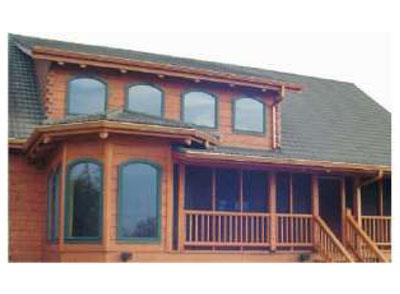
All log homes should be equipped with gutters. One of the most common problems we see is deterioration of lower log courses due to splash up from rain coming off the roof; however, gutters only work if they are kept clean. Blocked gutters provide ideal moist environments for a wide variety of insects including carpenter ants and termites. Although subterranean termites typically live in soil, they can also establish nests above ground as long as there is a consistent source of water. These types of termite colonies are known as aerial infestations and, if left unattended, the termites can cause significant damage over the course of several years.
Chimney Caps
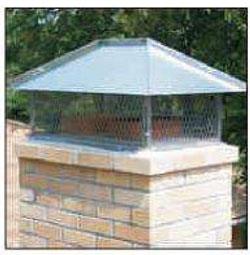
If you don’t already have a cap on your chimney, they are a good investment. It is not uncommon for squirrels, raccoons, and birds to take up residence in a chimney during the summer months and become a nuisance. Raccoons are often infested with fleas that can end up in your living areas.
Door Sweeps, Screens and Weather Stripping
Make sure that you have door sweeps installed on all doors accessible to the outside and check to see if they are in good working order. If you can see visible light coming in at the corners they need to be replaced. It only takes a gap of 1/4” for bugs and mice to gain entry. While you are at it, check the bottom seal of your garage doors. Once mice get into your garage they will probably find a way to get into your living area, too.
Windows are the most common entry points for flying insects in particular. Flies, ladybugs, boxelder bugs, stink bugs, and flying ants are just a few of the insects that can find their way into your home through the windows. Check to see if there are any rips or tears in your window screens, and make sure that the screens fit tightly into the frame. See if the weather stripping is still flexible and maintaining a tight seal when the window is closed. If you have sliding glass doors, check them too.
Weather stripping has a lifespan of about ten to fifteen years so if yours is hard and brittle, it’s time to replace it.
Attic and Crawl Space Vents
Normal window screening is not enough to deter determined pests like squirrels. They can gnaw through normal window screening in a matter of a few hours. To prevent entry of bats, rodents, squirrels and raccoons use 1/4” hardware cloth on the outside followed with small mesh screening on the inside to keep out wasps, ladybugs and large ants.
Caulks and Sealants
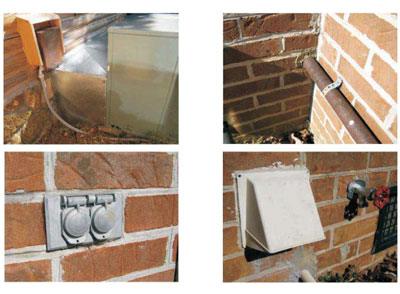
If you take a walk around your home and count possible insect entry points, you may be surprised at how many there are. Besides all of the windows and doors you’ll find electrical, telephone, cable, gas, outdoor faucets, air conditioning, and plumbing entry points. If you have a crawl space, you may have a number of vents, plus a door. And don’t forget your clothes dryer vent. All of these are common entry points for insects and rodents.
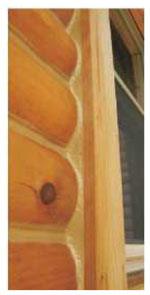
Let’s first address windows and doors. Round log or log sided homes, in particular, present a real challenge when it comes to sealing around windows and doors. All too often once a window or door is set into place, the edges of the opening are covered with a piece of trim and that’s it. Rarely is the trim properly sealed to the logs and large voids behind the trim are left empty (see “Log Gap Cap and Energy Seal” and “How to Apply Energy Seal and Woodsman” for the proper method for sealing around windows and doors). If these voids are not filled, they become perfect nesting sites for several species of ants, many of which will get into your home.
A good product to use for filling these voids is a Log Gap Cap™. A Log Gap Cap is a pre-cut foam insert that is available in two different sizes that fit most log profiles and log diameters. Once in place, the Log Gap Cap needs to be covered with a layer of Energy Seal™ or Woodsman™, since direct UV light will degrade the foam fairly rapidly.
Foundation vents also need to be sealed to the walls. Screening the vents won’t do any good if open gaps are left between the vent housing and the wall. If there is room for backer rod be sure to use it. If the foundation is brick, block or stone, Energy Seal in gray provides a good color match to the existing mortar.
Examine all of the electrical and plumbing penetrations mentioned earlier. Most were probably initially sealed with mortar. Most likely you’ll find cracks or gaps where the mortar has fallen out over the years. If a cheap construction caulk was used, it’s probably hard and brittle. Try to dig out as much as you can and replace it with a high-quality sealant like Energy Seal or Woodsman. When properly applied, they will keep those pesky bugs out of your home for many years to come.
Common locations to seal in home:
Pesticides
We at Perma-Chink Systems, Inc. discourage the broadcast use of pesticides just to keep nuisance pests out of your home. We are a firm advocate of Integrated Pest Management and since there are so many mechanical methods of control available to homeowners, we believe that they should be used as the primary means of preventing pest invasions. Pesticides should be used only as absolutely needed. Yes, there are situations when the use of pesticides may be the only solution to a problem but you may be surprised how effective some of these simple mechanical recommendations can be.

By Jared Turner
Folks have been trapped inside their homes for lengthy periods of time this winter. Whether it was to escape the cold or shelter from Covid, you are ready for a change. So, as you emerge from your long winter hibernation, take time to stretch, rub the sleepy out of your eyes and put the coffee on. Once you have all of that out of the way, it is time to open your door to Spring and consider the benefits of Forest Living.
For most folks, exposure to forests and trees has wonderful health benefits. For example, both of my parents happen to live in a densely populated urban area. However, each spring and fall they take the time to travel hundreds of miles to dive deep into the forests of Appalachia. They, as well as millions of others, have found these trips to be beneficial to their overall health and wellbeing.
So, what is it about the forests that make them so wonderful for our health? In recent years there is evidence that link people’s exposure to forest with a strengthened immune system, lower blood pressure, reduced stress, improved mood, increased energy level and improved sleep. What is not to like about this list? I believe many of us would be thrilled with improvements in these areas.
Are there other benefits that forests bring to our lives? Absolutely! They help to remove harmful pollution from our air by behaving like giant environmental filters removing harmful toxins from the air we breathe. In addition, forested watersheds provide quality drinking water for over 180 million Americans. Not only do trees filter through the air they also filter through the ground. With temperatures on the rise in most places, forests also help to lower air temperatures by 20-45 ֯F. The evaporation of water from trees has a wonderful cooling influence! Trees absorb carbon dioxide, a harmful greenhouse gas, and store it as carbon while releasing beneficial oxygen back into the air. In addition, trees, properly placed around your home, can help reduce your energy consumption by lowering the cost to cool your home. Finally, trees provide a wildlife habitat for animals to live and thrive.
Densely populated urban areas are just now catching on to all these benefits and are working hard to transform their cities by planting more trees and providing more green space for their citizens. They rightly understand that this approach is part of a more sustainable future. However, living this close to nature does bring with it challenges. At Perma-Chink Systems® we have been helping homeowners live in harmony with nature for over 40 years and as more folks transition to Forest Living, they are going to need a partner who knows how to integrate the two successfully.
Perma-Chink Systems happens to be a one-stop shop for forest living. We supply knowledge, experience, and quality products to help meet the needs of homeowners living in the forest. For example, with spring comes trees blooming and plants flowering, bringing with it pollen and dust. All this dirt, dust and pollen collecting on your home creates challenges for the longevity of your finish system. Once or twice a year we recommend giving your home a good washing. To help with this need we have developed Log Wash™, a highly effective, low pH cleaner designed not to damage your logs or your finish. By removing these contaminates, it will cut down on mold growth and damage caused by absorption of water and sunlight on your finish.
Spring is also a wonderful time to conduct an inspection of your home. Look for damage that needs repaired, cracks or openings that need to be sealed, and observe the overall condition of your finish system. Depending on what you discover, Perma-Chink Systems has products designed to solve most of your needs. We at PCS are actively helping to transition folks to a healthier way of life through a more sustainable Forest Living lifestyle. Please take some time to visit our website for more information.
Just as clear coats are vital to the performance of today’s automotive finishes our Advance Topcoats are an integral part of all of our exterior finish systems.
Not only do they extend the life of the color coats but they do much more. They significantly improve the look of the finish by enhancing the color, clarity and depth of the finish. In other words, they make our finishes the most beautiful log home finishes in the world. Second, they help keep the surface clean. The very nature of a pigmented stain makes it susceptible to dirt pick-up through adhesion or impregnation.
Since we have designed Advance to form a smooth, strong film it makes it much more resistant to dirt. In addition, the smooth surface makes it easy to clean off any dust or pollen that may accumulate on the surface of the logs. A simple wash down with Log Wash and a garden hose will remove the dirt and grime that may be hiding the beauty of your home.
Another feature a smooth topcoat provides is greater resistance to the growth of mold, mildew and algae. In addition to water these organisms need something to grip onto. If the spores land on a tough smooth surface that rapidly sheds water they won’t have an opportunity to germinate and spread. So the surface of your logs stays free of unsightly mold spots and patches of algae.
Of course the best feature of Advance Topcoat is the protection it provides to the color containing stain. Years ago cars left the manufacturer with a coat of paint. More expensive cars may have had several coats of paint but no matter how many coats were applied after a few years on the road the paint turned dull and started to flake off. Then car coating experts discovered the benefits imparted by clear topcoats. Today’s car finishes remain shiny and last longer than ever thought possible all due to the application of clear topcoats.
What is it about topcoats that contributes to this improvement? The most performance enhancing feature of a clear topcoat is that it reflects sunlight. Sunlight is composed of several components including ultraviolet (UV) light. It’s the UV that is responsible for fading colors and, in the case of wood homes, damaging wood fibers through a process called photo-oxidation. The more UV light that’s reflected off the surface the slower the color coats will fade and the less the wood fibers will be exposed to photo-oxidation thus extending the life of the entire finish system. Although satin finishes reflect a significant amount of sunlight, gloss topcoats reflect more which is why car finishes are shiny and not dull. The same holds true for our Lifeline exterior finish systems. Advance Satin does reflect much of the sunlight but Advance Gloss reflects even more, which is one of the reasons that log home gloss finishes are becoming more popular.
An additional beneficial feature of a clear topcoat is the protection it provides to the color coats against degradation by airborne contaminates like sulfur dioxide, ozone and particulates. Even natural contaminates like tree pollen and bird droppings can damage or discolor the color coats by chemical reactions or supporting mold growth. Our Advance Topcoats provide a barrier that prevents this from occurring.
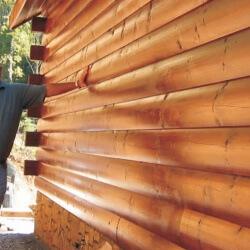
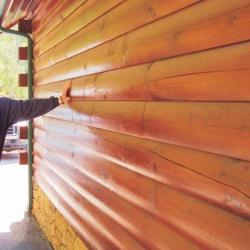
Although most people use brushes to apply our finish removers they can be applied with airless sprayers as long as you know what to do. Here is some information that will guide you in using airless spray equipment to apply both S-100™ and StripIt®.
Airless Spray Equipment
Most quality airless spray equipment including the Airlessco SP200 available from Perma-Chink Systems will handle our S-100. On the other hand for applying StripIt, you will need a professional grade airless sprayer with an output of at least 0.54 gpm. In either case, there are a couple of minor modifications that have to be made before using them. The first thing is to change the tip to a 0.019 or 0.021 tip orifice. We stock universal 521 tips in case you cannot find one locally. If a smaller diameter orifice tip (<0.019) is used, it will take longer to apply the proper amount of finish remover and the tip may block up. In addition, since a small orifice produces a fine mist there is a greater chance of wind drift onto surfaces that you may not want to strip.
The second thing is to remove any sprayer strainers, screens and/or filters. Our finish removers are somewhat thick and viscous, so having to pass through screens and filters will impede the flow of product through the sprayer and may eventually block it. Once the stripping process is completed, it’s of utmost importance to replace the 0.019 or 0.021 tip with a 0.015 or 0.017 tip for applying our stain and topcoat.
S-100 and StripIt
Our S-100 Finish Remover and StripIt are formulated so that they can be applied “as is” using an airless sprayer. Their viscosity is such that they do not need to be diluted with water to be run through airless spray equipment. However, it is a good idea to thoroughly mix the S-100 with a Jiffy Mixer before spraying it. Just be careful to keep dirt and other debris out of the product.
Application
The first step before starting to remove a finish is to take off downspouts, gutters, and lighting fixtures, and mask off or cover those areas that you don’t want to strip or they may become discolored if contacted by the product you are using. The next step is to wet down and cover any plants and shrubs. Both S-100 and StripIt are pretty gentle on plant life once they are diluted with water during the stripping process, but in their concentrated form they may present a problem. The use of perforated weed blocking film works well over plants, roofs, decks and other areas you want to protect, since it allows water to drain through it but catches lumps of concentrated remover as well as any stripping debris. This makes clean up a lot quicker and easier.
Apply the finish remover to one or two courses of logs at a time in a sweeping motion across the entire wall starting at the bottom of the wall. This will help you avoid coating the chinking or sealant joints if they are present. Be sure to only coat an area that you can finish stripping in the allotted time you have. If you coat the entire wall or too large an area the finish remover may end up drying on the wall and become difficult to remove. Always apply finish removers at the recommended thickness or coverage rate. If applied too thinly, they may not work and you will have wasted your time and money. Once the finish remover has been applied to an area, submerge the spray gun and tip in a pail of water to prevent the product from drying at the tip and possibly blocking it.
After waiting an appropriate amount of time for the stripper to soften the finish (remember the cooler it is the longer it will take), you can begin the pressure washing process. Be sure to wash off any product and wet finish debris that’s still adhering to the wall or other surfaces. If allowed to dry, you may end up having to manually scrub these surfaces clean. Once you reach the top of the wall, or if you run out of time, rinse the entire wall starting at the top before you quit. You don’t want any chemical or finish debris to remain on the surface. If you are through for the day, replace the lid on the pail of finish remover and run clean water through your airless sprayer until clear water comes out of the gun.
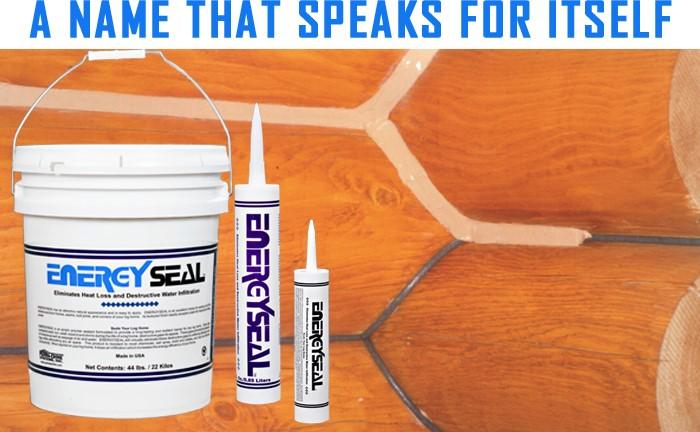
Start saving on your heating and air‑conditioning bills now!
Energy Seal™ is a textured acrylic polymer sealant that provides a long-lasting and resilient seal for any style of log home. Since logs constantly twist, turn, swell, expand and shrink, gaps may appear between logs or between the logs and window and door frames or other areas of the home. These gaps retain moisture and allow the seepage of air and water into the home. Energy Seal eliminates these gaps by forming an air and watertight barrier over them.
So why do people use textured sealant Energy Seal?
First and foremost, to keep water, air and bugs out of places where they don’t belong; second, for its attractive appearance; and third, for the reputation of lasting longer and performing better than competitive products. It should not come as a surprise that log homes are a bit difficult to seal up. When you stack logs on top of one another to make a wall, the logs do not naturally fit tightly to one another so there are usually gaps that must be sealed to prevent air and water from getting inside. That’s what Energy Seal is designed to do.
Most people call log sealants “caulk” but we try to refer to them as “sealants” to help differentiate high quality products from cheap caulks that can be bought at any hardware store. Plus, several of our sealants do not fit the conception most people have of a typical caulk.
There are two reasons that Energy Seal is textured. First, it allows the surface of cured Energy Seal to remain looking “flat.” It does not have that shiny look common to most types of caulk. This allows Energy Seal to blend in with the surrounding stained wood. Second, the texture allows Energy Seal to better accept a stain so that it can virtually disappear on a wall.
Here is a TIP; if you plan to stain over Energy Seal, select a color that’s just a bit lighter than the stain you plan to use. It’s much easier to cover light-colored Energy Seal with a darker color stain than it is to cover dark-colored Energy Seal with a light-colored stain.
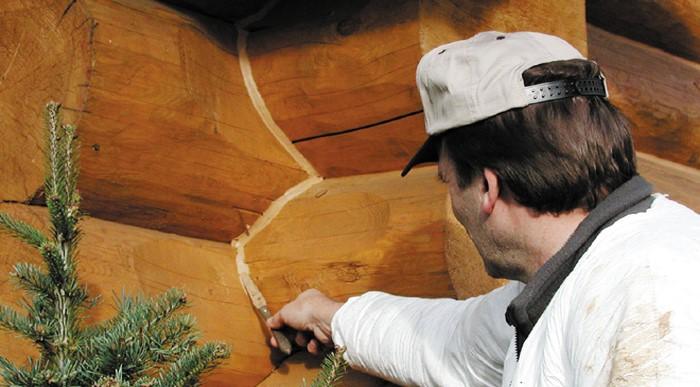
Applying Energy Seal
Before Energy Seal is applied, the surface must be clean, dry, and free of oil, wax, or anything else that will interfere with the adhesion of the sealant.
Wherever possible, Energy Seal should be used along with Backer Rod or Grip Strip™. If backing material is not used, there may not be enough room for the Energy Seal to expand and a crack may appear across the joint. Backer Rod should be used even if the joint is narrow. The width of the band of Energy Seal may end up a bit wider than you expected but the integrity of the seal will be maintained.
Applying Energy Seal over old caulk is never a good idea even if it looks like the caulk is still adhering to the wood.
Although it can be time consuming and somewhat difficult, old caulk should be removed for several reasons. If a caulk no longer adheres to the wood, it may be due to moisture getting under the caulk creating rot. The old caulk must be removed to properly treat and seal the wood, so the new sealant does not fail.
Once in place, Energy Seal may be tooled smooth with a trowel or putty knife. Spraying a light mist of water on the surface will make tooling a lot easier and will result in a smoother surface.
If masking tape is used to protect the surrounding wood be sure to remove the tape while the Energy Seal is still wet.
To protect recently applied Energy Seal from the weather, a loose covering of plastic film will prevent it from being washed out of the joint until it cures enough to withstand a heavy rain. Typically, a week or so is sufficient.
For more information about Energy Seal, give us a call 1-800-548-3554 or check out our Log Home Sealant Application Guide
HOW TO SEAL AROUND WINDOW AND DOOR FRAMES
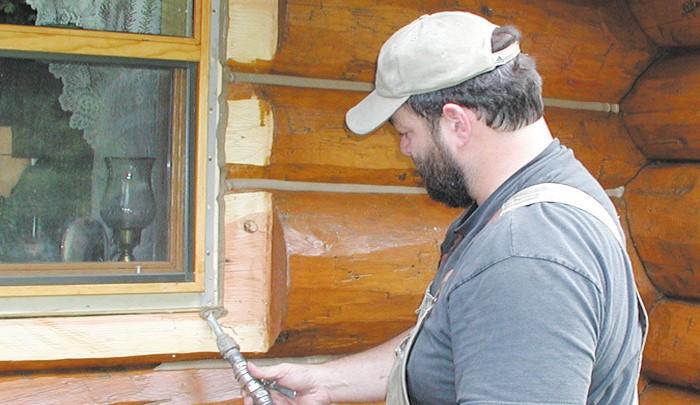
We have an excellent tutorial on sealing around windows and doors using Energy Seal and Log Gap Caps.
During the winter months it’s important to be aware of the freeze-thaw stability of Perma-Chink Systems’ products. The reason may involve shipping conditions or whether it is okay to store a product or products in an unheated shed. In any case you need to be aware of the consequences of allowing any of our products to freeze.
Without a doubt it is always best to prevent any of our finishes and sealants from freezing. They all contain water and the formation of ice crystals within the products can separate the water from the other components. In some products once this occurs it becomes impossible to regain the properties of the original formulation even after thawing and vigorous mixing.
With a few exceptions most of our products are freeze-thaw stable, however, if a product becomes frozen it needs to be thawed slowly, preferably at room temperature. Speeding up the thawing process by heating the container can seriously damage the product making it unusable. If the product is in pails or containers, once it has completely thawed it will require a thorough mixing.
If a product is subjected to multiple freeze-thaw cycles each cycle will contribute to the degradation process until it is no longer suitable for use. If a product becomes frozen it is better to allow it to stay frozen than it is to bring it inside to thaw and then store it where it may freeze again.
It’s the succession of freeze, thaw, freeze, thaw sequences that really destroys the integrity of a product. Before applying any product that’s been frozen be sure to test a small amount to see if it is still usable.
To reiterate:
- It’s best to protect all of our products from freezing.
- If it does get frozen, thaw it slowly at room temperature then thoroughly mix it.
- It’s better to keep it frozen than to subject it to multiple freeze-thaw cycles.
- Before applying any product that’s been frozen be sure to test a small amount to see if it is still usable.
Perma-Chink Systems’ products that are NOT freeze-thaw stable:
- Chink Paint™ Textured & Smooth
- Log End Seal™
- Oxcon™
- StripIt™
Perma-Chink Systems’ products that have limited freeze-thaw stability (5 cycles):
If you need cold-weather storage guidance for a product not shown, just give us a call at 800-548-3554 – we’re happy to help!
During the winter months it’s important to be aware of the freeze-thaw stability of Perma-Chink’s products. The reason may involve shipping conditions, or whether it is okay to store a product or products in an unheated shed. In any case, you need to be aware of the consequences of allowing any of our products to freeze.
Without a doubt it is always best to prevent any of our finishes and sealants from freezing. They all contain water and the formation of ice crystals within the products can separate the water from the other components. In some products once this occurs it becomes impossible to regain the properties of the original formulation, even after thawing and vigorous mixing. These types of products are not freeze-thaw stable.
With a few exceptions, most of our products are freeze-thaw stable. However, if a product becomes frozen it needs to be thawed slowly, preferably at room temperature. Speeding up the thawing process by heating the container can seriously damage the product making it unusable. If the product is in pails or containers, once it has completely thawed it will require a thorough mixing.
When a waterborne product is subjected to multiple freeze-thaw cycles, each cycle contributes to the degradation process until the product is not suitable for use, i.e. gelation or coagulation of the product. If a product does become frozen it is better to allow it to stay frozen than it is to bring it inside to thaw and then store it where it may freeze again. It’s the succession of freeze, thaw, freeze, thaw sequences that really destroys the integrity of a product.
Before applying any product that’s been frozen, be sure to test a small amount to see if it is still usable.
To reiterate:
- It’s best to protect all of our products from freezing.
- If it does get frozen, thaw it slowly at room temperature then thoroughly mix it.
- It’s better to keep it frozen than to subject it to multiple freeze-thaw cycles.
- Before applying any product that’s been frozen be sure to test a small amount to see if it is still usable.
Perma-Chink Systems’ products that are NOT freeze-thaw stable:
- Chink Paint™ Textured
- Chink Paint™ Smooth
- Log End Seal™
- Oxcon™
- StripIt
Perma-Chink Systems’ products that have limited freeze-thaw stability (5 cycles or less):
- Lifeline™ Ultra 7
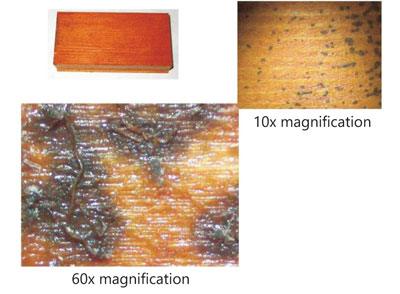
Most of the Directions for Use for our finishes contain the statement “Do not use Lifeline™ on surfaces that have been brushed or rubbed with steel wool or a wire brush. If you do, rust spots may appear under the finish.” Fortunately we rarely see the consequences of applying one of our finishes over a wall that has been rubbed or brushed with steel wool or a wire brush, but occasionally it does happen.
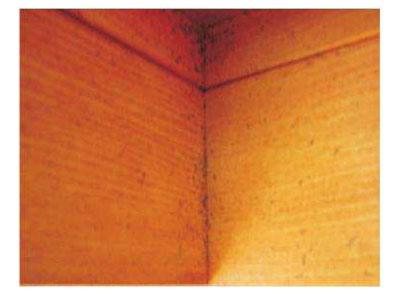
The customer who took this picture thought that the dark spots in the corners were due to mold; however, they appeared within just days after the finish was applied. We were able to obtain a small section of the discolored wood and just looking at it gives the impression that the discolorations could well be mold, or some flecks of dirt that may have been present at the time of staining. Even under the microscope at 10X magnification, there’s no indication of what caused the black spots.
But at 60X magnification it quickly becomes apparent that every black spot is associated with some type of fiber imbedded in the film. These fibers are bits of steel wool. Since the black spots are concentrated in the corners, it’s evident that someone had tried to wipe the wall clean but missed the corners entirely.