For the past 40 years the most accepted and effective method for preventing infestations of wood destroying insects and decay fungi in log homes has been by impregnating the wood with a solution containing the element boron.
Boron salts are referred to as borates and the most used borate utilized for this purpose is disodium octaborate tetrahydrate (DOT), the active ingredient found in Tim-Bor®, Bora-Care®, and PenaShield®. The reason for using this material instead of borax or boric acid is because it has a much higher boron content per pound and is significantly more water soluble than other boron
containing compounds.
But what is it about boron that makes it so effective for preserving and protecting wood? In the case of wood consuming insects like termites, it is postulated that boron interferes with the metabolic process and inhibits protozoan symbiotic activity that allows the insects to digest cellulose. These modes of action may take some time, and it is not unusual for insect activity to continue for several months after being exposed to a borate treatment. However, once eliminated, the wood will be protected from future wood consuming insect infestations if the boron remains within the wood’s
cellular structure.
In the case of decay fungi, it is thought that the presence of boron disrupts the cellular production of enzymes that allow the fungi to extract nutrients from the wood. As opposed to insects, a borate treatment can kill decay fungi rather rapidly, usually within a day or two depending upon several factors, i.e. borate concentration, fungi type and wood moisture.
Borate Treatment Methods
Pressure Treatments
Pressure treating wood with preservatives dates to the 19th century when railroad ties were impregnated with creosote under pressure. Since then, several chemical formulations have been used for pressure treating logs and dimensional lumber, but most have been discontinued due to their toxicity or health and environmental hazards.
Due to their low mammalian toxicity and environmental friendliness, borates are now being used by several pressure treating companies for treating both logs and dimensional lumber. The one limitation of borate pressure-treated lumber is that it cannot be used for wood in contact with the soil since the moisture in the soil will extract out the water-soluble borate within a few years.
Dip Treatments
Several log home manufacturers dip their logs in a solution of borate before they are shipped to the customer. Although there are set standards for the “Dip Diffusion” process, very few companies meet these standards since it requires dipping green, unseasoned logs in a hot, concentrated borate solution and then storing the logs in a covered building for a minimum of two weeks.
Most log suppliers simply dip their logs in a borate solution for a few minutes then allow them to dry. Although this procedure does not meet set standards, it has been used for over 30 years and if the borate concentration in the dipping solution is maintained at or above 10%, we rarely hear of this process not providing adequate protection to new logs.
Topical Treatments
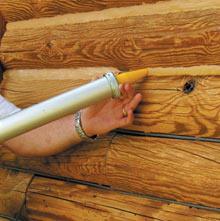
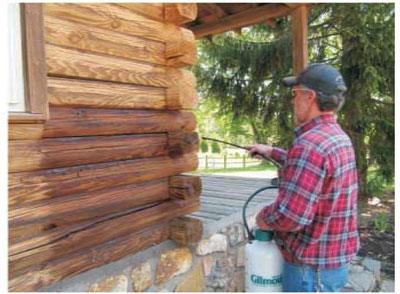
Back in the late 1980s Perma-Chink Systems developed the very first borate preservative that could be applied to wood in the field during or after construction. Since then, hundreds of thousands of log and conventionally constructed homes have been borate treated using the technology originally developed by Perma-Chink Systems. What made this possible was combining the borate with a combination of glycols that allow the borate to penetrate the wood rather than remaining just on the surface. In addition, the glycols increase the efficiency of boron, allowing less applied product to be just on the surface. This technology is incorporated in both PenaShield® and Bora-Care®.
Pure borate / water solutions like our Tim-Bor® are also used for topical applications but since they do not contain anything that aids in the penetration of the borate into the wood, we recommend that they be used only on new, un-infested logs and be reapplied any time the home is stripped of its existing finish.
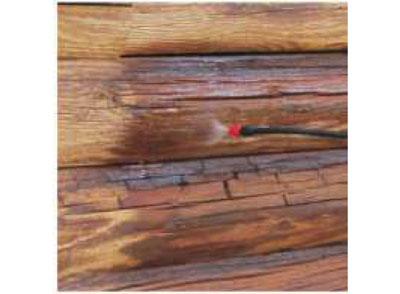
The one limitation of any topically applied borate is that it must be applied to bare wood. If there is anything on the surface that inhibits the absorption of water into the wood the borate solution will remain on the surface and no protection will be imparted to the wood itself.
Conclusion
The success rate of properly applied borate treatments is truly astounding. In the 40 years that we have been involved with borate treating wood the number of reported complaints is miniscule and most of them involve insects that do not consume wood for nourishment like carpenter bees, parasitic wasps, house ants and other pests that are not included on the label. We occasionally get calls about a continuing beetle infestation after a borate treatment, but it is almost always within a week or two of the products being applied and that’s just not long enough for the borate to eliminate an active infestation of wood boring beetles. However, once the borate has had time to work and the activity ends, that is the end of the infestation, and they never return.