
Blog

How about EuroPlast?
Looking for just the right compliment to enhance the interior walls of your dream home? Consider the ageless appeal of Venetian plaster. For centuries architects, designers, builders, and owners alike have marveled at the splendor of this highly popular form of wall surfacing, and throughout the ages the artisans who were skilled at creating such beauty have been revered and sought after. With today’s advanced technology, you can now have this distinctive elegance and appeal at a fraction of the cost- in as little as two days.
EuroPlast and Euroseal by Stuc-O-Flex International
Consider this revolutionary approach to dramatic design. EuroPlast is a pre-colored, acrylic polymer-based interior and exterior coating system that transforms vertical walls into a classic example of old world Venetian-style plaster. This versatile decorative coating exhibits a rich aesthetic appearance with an unlimited selection of color and texture opportunities. Achieve a wide range of effects from rustic plaster to smooth polished limestone.
EuroPlast is a decorative finish providing color, texture and hard durable surface that resists staining, dirt pick-up, and abuse. Applications easily go over interior and exterior surfaces including stucco, concrete, brick, block, plaster, cement-board sheathings- even primed drywall for interior applications.
Euroseal is a pure acrylic sealer that is applied over the EuroPlast finish. Euroseal has a unique ability to transform newly constructed walls into a classic example of centuries-old plaster. This semi-transparent sealer is formulated to obtain an uneven antiqued, or “mottled,” appearance. Euroseal is available in clear or in an unlimited selection of semi-transparent colors. The material can provide a high level of gloss or an eggshell appearance, depending on your design requirements. Euroseal colors are available in pre-tinted containers, ready to apply. The product is intended to create an old world or weathered look while adding a striking characteristic to completed walls.
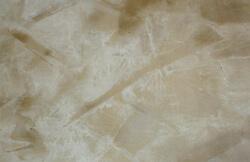
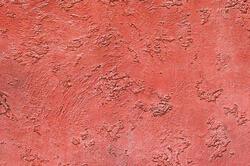
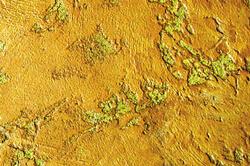
If this unique product might be that one element to compliment and enhance the beauty of your dream home contact Stuc-O-Flex International, Inc @ 1-800-305-1045 or e-mail: techservice@stucoflex.com


So how do our Communication and Distribution Systems work and how are they different from other suppliers?
Communication
Our Communication System is a nationwide VOIP Internet-based system. That means that each of our Branches and our Knoxville, Tennessee Factory are connected 24/7 like a large office – but the office is nationwide. Answering calls, forwarding calls, etc., happen nationwide the same way as a direct call to a local office are.
That means that every office and every sales desk is connected with a simple stroke of a keyboard. In addition, our Call Forwarding capability automatically connects an incoming call anywhere in the nation. Yes, at times you may be connected with a Customer Service Representative other than the one you typically talk to, BUT – the CSR that does answer the call has your entire order history on the screen in front of them immediately. That is thanks to our second system, which is an online database.
Each time an order is placed, whether it be from a new Retail Customer, or an existing Applicator, Dealer, or Manufacturer, the order is entered in real time into our Accounting Database. That database is immediately updated with any new Customer data – purchased products, colors, quantities, shipping addresses, etc. That means that any order that customer has ever made is instantly available on the screen, and we can tell them anything the customer has ever ordered (for example: I bought Lifeline Ultra-7 for a project 8 years ago and I forgot the color and now I need some touch up and additional for a garage, and by the way, that was for the Rutherford house in Pigeon Forge, not the Pinkerton house in North Carolina). We can tell you in real time what stain was used, what color, how much was purchased, when it was purchased, and where it was sent to. Every CSR in the company has that information, for every customer, on the screen in front of them as soon as the call is answered. Then, if the customer would like to talk to a particular individual (my ‘favorite’ salesperson), we can use the same network to send a notification to that CSR to call you back or attach any particular notifications for the order.
Because of the time difference from the East Coast to the West Coast, this system is available from 8:00 AM Eastern Time until 5:00 PM Pacific Time. That means that a call placed at say, 8:00 PM, on the East Coast will be answered by a salesperson in Redmond, WA that has your Customer History and can take the order or answer any question. That also says that you can make a call at 5:00 AM in Washington State and place an order with a CSR in Tennessee. That is a tremendous advantage for a Contractor who needs to place an order before normal business opening times, or after normal business hours. Remember, it doesn’t make any difference who answers the phone or where they happen to be – they have your Customer History on the screen in front of them and can take the order, handle shipping, and answer any questions you might have – and make the order at your particular price level.
Distribution
If you can’t get the product when you need it, it’s all for naught. If you are an Applicator, Manufacturer, or a Homeowner, you all need the product available at a particular time. Products that arrive a day or two late, or a week late, cause havoc with application crew scheduling or weather changes, and can reverberate through the season if early season jobs are late and will negatively impact schedules.
Our Manufacturing Plant is in Knoxville Tennessee, centrally located in the heart of the Log Home Industry. It is also located at the intersection of the major North/South and East/West highways. It’s no coincidence our factory is in that location! We of course have massive ‘Whole House’ inventories (products for an entire home project), but that location also feeds seven fully-stocked Whole House Company-owned Branches. Each one of those Branches is stocked with a Whole House inventory. Not one or two ‘Overage or Sample’ inventory. Additionally, each Branch location can make any custom stain color you desire and also stocks inventory for a number of Independent Distributors.
The point here is that we are located at strategic locations across the USA and are well-stocked to handle anything from multiple Whole House orders to samples and anything in between. These locations disburse our inventory so that we can fulfill orders from a number of large stocking locations that are close to you, our customers. We are not dependent on large inventory shipments or Whole House shipments arriving from one location. This drastically lowers shipping time and expense.
In addition, each of our seven Branches is staffed with a minimum of three experienced Log Home Specialists. Larger Branches have five and up to eight Inside Customer Care Specialists. No matter when or who you call, be assured you’ll be connected with Industry Experts that can help you get the right product at the right time.

While adequate air exchange is essential for health and safety, many older log homes have a far higher rate of air exchange than is necessary. This is often due to poor design and/or construction which allow air leakage from the inside or outside of the building, but log homes are additionally prone to settling, seasonal expansion and contraction of the logs, and other factors that can cause log joints to move over time.
Given that the typical 30 x 40 log home can easily have more than a linear half mile of log-on-log surface area, determining leakage pathways is often complex and extremely difficult to visualize; leaving log homeowners no other choice than to apply a sealant to all log joints in hopes of locating and correcting the problem areas.
To identify areas of energy waste, infrared thermal imaging has quickly become a valued tool in identifying problems related to energy loss, water and insect infiltration, inefficient HVAC systems and much more. A thermal imaging camera identifies patterns of heat loss that are invisible to the naked eye and quickly indicates the air leaks within the log home with measurement data that can easily be compiled into a written report.
Professional log home applicators are using leading-edge infrared technology coupled with a computer controlled blower door to depressurize the home to an industry standard of -50 pascals, which simulates a 20 mph wind blowing on all four sides of the structure simultaneously. As air is drawn through failed log joints the temperature of the log surfaces changes, producing a thermal image that can be recorded. This allows the applicator to accurately identify and repair the problem areas to stop the energy loss immediately.
Wayne Bell, owner of Log Home Care, uses this technology and reports: Thermal imaging provides both an immediate cost benefit from the reduction in labor required to seal the home and future savings on energy costs. The computerized blower door provides information about air exchange within the structure, expressed in square inches, which can easily be understood when expressed in terms of an open door or window.

“Don’t confuse this equipment with the inexpensive infrared thermometers sold at home improvement stores,” Wayne clarifies. “Advances in technology have reduced the prices of this equipment but it still represents a major financial investment for the applicator. Prices vary by applicator, but homeowners can expect to spend several hundred dollars for blower door testing and thermal imaging services, but a portion of that charge is rebated back as a credit to the homeowner if our firm does the sealant work”, says Wayne.
“Whether we simply provide a printed report that illustrates what needs to be done or we handle the entire process of applying sealant to the home, our company couldn’t be happier with Perma-Chink Systems products. When dealing with log joints that may allow for both air and water infiltration, we use Energy Seal and backer rod on the outside of the structure. If the joint is leaking air but there is little risk of water infiltration, we can alternately use Check Mate 2 (often the clear color) in the interior if needed, but our preference is to do our sealant work on the exterior surfaces. By reducing air leakage, the homeowner obtains a better level of comfort in their log home and Perma-Chink Systems provides the products to make that possible.”
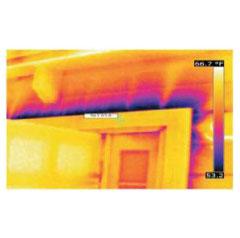
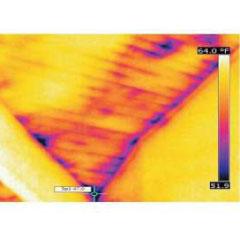
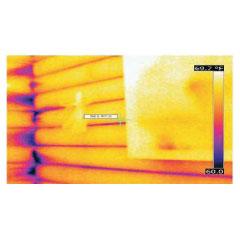
The home featured in these photos indicated an open surface area of 66.5 square inches which equates to a 24” wide window being left open nearly 3” but many log homes exhibit air exchange rates several times higher.

Bora-Care®, PenaShield®, and Tim-Bor® are all used as solutions that contain water. Since time and cold temperatures affect each of these products somewhat differently, we’ll address each product individually.
For proper use, Bora-Care can be mixed in three different ratios, which are 1:1, 2:1, and 5:1. Unmixed Bora-Care concentrate can remain stable for many years. Bora-Care needs to be stored in a cool, dry storage area inaccessible to children and pets. Do not allow Bora-Care to freeze. If Bora-Care is allowed to freeze, then it can make it ineffective.
For example, if you are making a 1:1 ratio, you will use equal parts of Bora-Care and water. Using warm water makes it easier to mix, but it’s not necessary to use warm water. Once the 1:1 and 1:2 solutions are mixed with water they must be used within 24 hours. The 5:1 solution will remain stable for up to 30 days. The reason for this is after 24 hours or so borate salts will begin to drop out of solution forming white crystals on the sides and bottom of the container. If left in the spray equipment for too long these crystals will block up the spray tip and/or filter screen and once crystalized, they are very difficult to dissolve. The colder it is, the faster the borates will drop out of the solution.
If you have mixed Bora-Care that you want to keep, you need to get it out of your sprayer ASAP and into a plastic container. Thoroughly rinse out your sprayer as soon as possible. Although borate crystals will form in the container, if the mixed solution is heated to about 95°F there is a good chance that the crystals will re-dissolve. Furthermore, if the solution is not used within 24 hours the borate crystals will start forming again.
One common assumption about PenaShield is that it is simply Bora-Care that has already been mixed with water. This is not the case. PenaShield is an entirely different formulation than mixed Bora-Care. Although the chemical components are the same as those in Bora-Care they are present in entirely different ratios that help keep the borate salts in solution. If PenaShield is subjected to cold temperatures (less than 40°F) for extended periods of time, there is a chance that some of the borate salts will begin to coat the inside walls of the container. This is not a sign that the PenaShield is freezing, it’s just that the temperature has reached a point where the solubility of the borate salts has dropped below 10%. Like most salt solutions, the lower the temperature, the less salt will remain dissolved in water. Once this occurs the solution needs to be warmed up to 80 to 90°F for the borate salts to re-dissolve.
The best way to warm it up is to fill a bucket with hot water, put the container of PenaShield into it, then after an hour or so take it out and shake it until the crystals disappear. With 2.5-gallon containers it’s a bit more difficult to do this unless you can find a large bucket. However, you can fill a bathtub or kitchen sink with hot water and do the same thing. Just placing the containers in a warm room will not heat the solution up enough to dissolve the borate salts. You will want to ensure that you store PenaShield away from areas children and pets may gain access to. PenaShield should also be protected from freezing.
Tim-Bor is typically used as either a 10% solution by dissolving one pound of dry borate powder in one gallon of water or a 15% solution by dissolving one and a half pounds of dry borate powder in one gallon of water. Using warm water speeds up the process. It should be mixed up in a bucket, not in a pump-up sprayer. Once the solution in the bucket is clear and there are no clumps of undissolved Tim-Bor, then it can be transferred to a garden sprayer. Tim-Bor solution must be used as soon as possible and should not be stored for an extended length of time.
Just like Bora-Care and PenaShield, Tim-Bor needs to be stored in a dry place where children and pets cannot gain access to.
Solutions of Tim-Bor can and will freeze if the temperature drops below 20°F. However, it is not worth trying to save or salvage Tim-Bor solutions that remain unused.
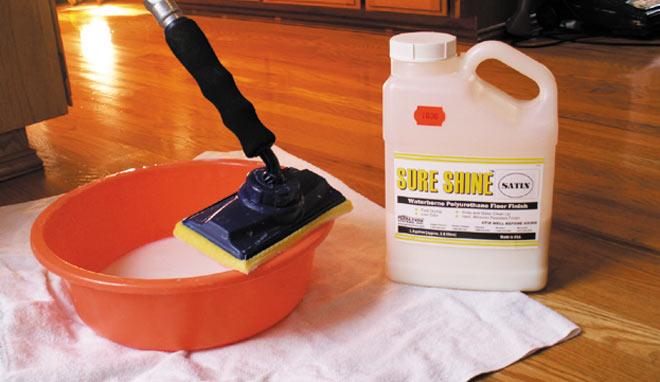
Sure Shine™ Gloss or Satin is a water-based, urethane-acrylic, interior clear finish for application on both horizontal and vertical surfaces; however, the application of a urethane-acrylic finishes is a bit different than those based on acrylic latex polymers. For example, our pigmented Lifeline™ stains and Advance and Acrylic Topcoats should be thoroughly mixed and brushed out as far as they will go. This may include vigorous back-brushing. However, this technique does not work when applying Sure Shine and its proper application is a bit different than any of our other finish systems.
Being a urethane-acrylic hybrid, Sure Shine is very susceptible to air entrapment. That’s why the label states to gently stir Sure Shine using a paint paddle or stick and not to shake or agitate the container as this creates foam that may result in air bubbles within the finish. Vigorously brushing Sure Shine will also entrap air resulting in a rough surface with lots of visible air bubbles.
For best results, Sure Shine should be applied with a good quality brush or pad using slow strokes. It can also be applied with a High Volume Low Pressure (HVLP) sprayer, but only spray small areas at a time and slowly back-brush. Since Sure Shine dries fairly rapidly, back-brushing must be accomplished within a couple of minutes of application. If it begins to dry, back-brushing will leave striations in the finish that will have to be sanded out if a smooth surface is desired.
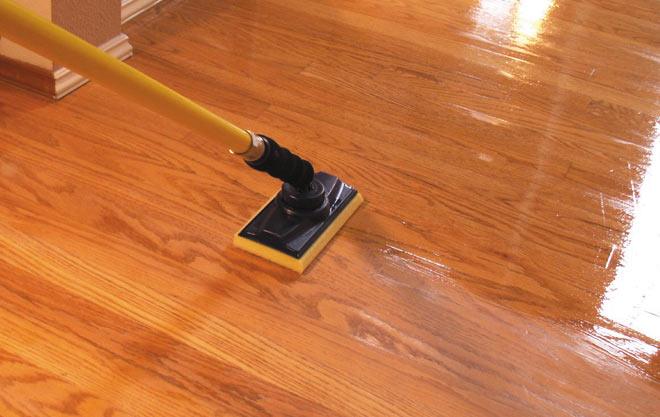
Another application tip about Sure Shine relates to sanding. Typically, the application of a water-based finish directly to wood has a tendency to raise the wood grain; therefore, the first coat of Sure Shine may not be completely smooth. Allow Sure Shine to dry for 1-2 hours before sanding is attempted. Lightly sanding with sandpaper (180 grit or higher) or a buffing brush to remove all of the small bumps, ridges, and other imperfections. If the film is just the slightest bit soft, sanding will generate little pills of finish and make a mess of the surface. Once the first coat is sanded smooth, subsequent coats of Sure Shine can be applied without sanding between coats.
If you want a smooth, deep lustrous finish on your interior wood surfaces, Sure Shine is hard to beat. And remember that Sure Shine can be applied over any of our interior finishes including Lifeline Acrylic Gloss and Satin.

Wayne Bell
Log Home Care Online
Have you ever wished that you could live in a log home but you’re stuck living in conventional housing? If so, join the growing number of people tackling home improvement projects to create a space that has the “feel” of log home living within the limitations of your current home.
Our project was to convert a roughly 30’x50′ unfinished basement in a contemporary suburban neighborhood into a space that would capture the tranquility of a northwoods lodge. Many of the design and construction techniques we used could just as easily be applied to any interior room, log home basement, or other living space. And best of all, most of the skills required are within the reach of the average handyman, so you can add significant value to your home with only a modest financial investment.
This space needed to harmonize with a contemporary home, so we used a mixture of log siding and drywall in the design.
We included a central fireplace as a gathering point for visitors, kitchen/bar area for entertaining, home theater, game room, guest bathroom and storage areas. To maintain the theme, we used natural materials wherever possible. We sketched out the space and made note of existing features (like the stairs, duct work, support beams and posts) so we could accommodate them in our design.

We’ve seen basement conversions that didn’t address the storage issue and that is a mistake so we framed in the corner that housed the furnace and other utilities to create a generous storage room.

Visitors are impressed with the functionality and attractiveness of the previously unused space. The extensive use of standard construction techniques allow for homeowner participation in the building process, and the use of log siding and natural materials provide for a dramatic effect. When it came to selecting the sealant and finish materials, we chose the same supplier that we have used to professionally finish hundreds of homes: Perma-Chink Systems.

It’s always fun to admire beautiful designs in log home publications, but with some creativity you, too, can enjoy the feeling of a log home wherever you live.
About the Author
Wayne Bell is a log home refinishing, repair and restoration contractor, serving the Midwest and southern United States from his base in Ohio. If you have questions about the materials or processes used in this project, you can contact him at 937-657-4565 or at www.LogHomeCareOnline.com.
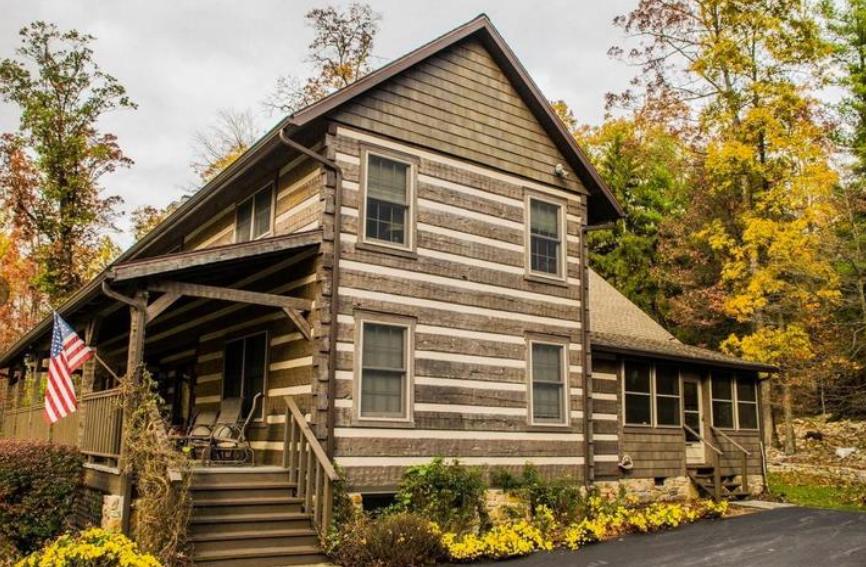
Have you ever considered the impact that landscaping can have on the well being and beauty of your log home? Let’s look at some things around your home that can significantly affect its health.
Trees
In summer months trees located close to your home can help provide shade which may lower your air conditioning costs. But if any branches are touching your roof they can provide pathways for insects and rodents to enter your attic and eventually your living space. It’s best to keep tree branches at least three (3) feet away from your walls and roof. This distance will discourage creatures like gray squirrels and roof rats from investigating your attic and help prevent carpenter ants from taking up residence inside your home.
Shrubs and Hedges
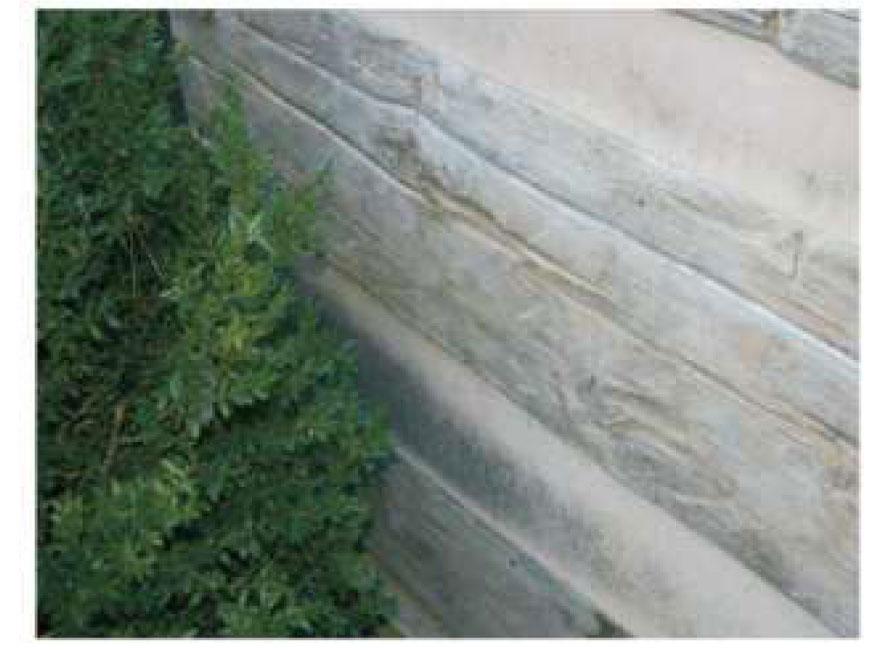
The next things to consider are shrubs and hedges planted next to your foundation. Over the years you’ve probably let them grow too large, and they may be getting close to your log walls, or even worse, actually touching the logs. In addition to keeping the logs damp, shrubs and hedges can actually wear the finish right off of the wood. You need to trim them back, if for no other reason than they are hiding the beauty of your home. There should be at least two (2) feet of clear space between any plants and shrubs and your foundation or log wall. This allows air to flow over the logs which helps keep them dry and free from insects, mold, algae and decay.
Plants and Grass
It’s quite common to see plants and grass planted right up against foundation walls. Even though they may not be in contact with the logs, they still provide a lot of moisture to the surrounding area and water is the enemy of wood.
Mulch
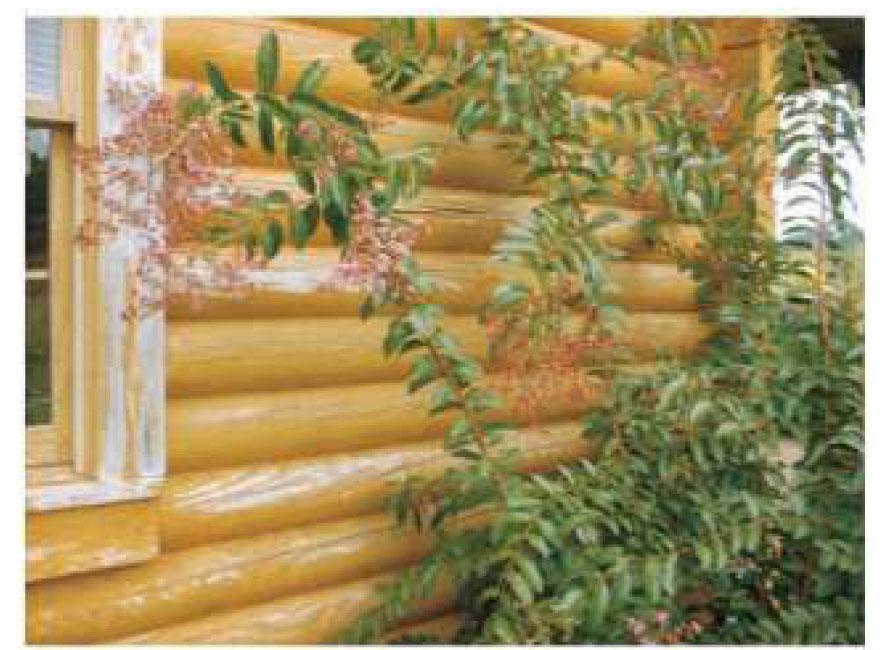
If you have flower beds around your home you probably use some type of mulch to keep the weeds down. The most commonly used types of mulch are shredded wood or bark, bark nuggets, or pine straw. All of these types of organic mulch materials attract a wide variety of insects including termites as well as wood decay fungi. In addition, over the years the decayed mulch builds up bringing the soil level closer and closer to the bottom course of logs.

Fall Landscaping Tips
To prepare for fall and winter seasons, here is a checklist to make sure your home and yard looks great. Here are our recommendations regarding landscaping around log homes:
1. There should never be any plant life growing within two (2) feet of the foundation, log, or siding wall. Any existing plants or branches within the two-foot zone should be removed or cut back.
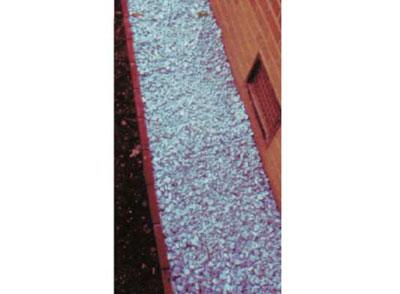
2. The best way to maintain an adequate clear space between your landscaping and home is to lay down a two to three foot wide band of landscaping fabric or perforated plastic around the base of your foundation and cover it with two to three inches of river pebbles or crushed stone (not wood or bark mulch). This will help keep the foundation area dry and you will be surprised how it will reduce the number of bugs you’ll see inside your home.
3. Make sure that your sprinkler heads are not spraying water onto the logs or foundation walls.
4. Take care of your lawn by overseeding, applying fall-specific fertilizer and weed control, and don’t forget to water your lawn (for areas where there’s no rain or snow).
5. Prune and trim trees and shrubs. Since blooms are done for the year, now is the time to cut them down.
6. Don’t forget to winterize sprinkler systems and related items. Don’t forget about outside water timers, too (I may or may not have experience forgetting to bring my timer inside one winter, and it may or may not have frozen and failed).
7. Plant trees, shrubs, and bulbs in October. This allows them to acclimate to their new home without the stress of a hot summer.
8. Rake leaves and clean-up other debris, composting what you can.
9. Place mulch around newly planted trees, but away from the trunk as this invites pests.

From Worst to First With Perma-Chink!
By John & Elaine Judsky
Suches, GA
Perma-Chink Customers Forever
I’ll admit the hard truth. I neglected the exterior of our log cabin in the North Georgia mountains. For years. It was ugly, and we needed restoration.
We had used Perma-Chink products on the interior of our new cabin back in 1999, with Sure Shine on our floors and the Lifeline Interior on our walls. They are holding up well and looking good after 16 years.
But the exterior was a mess from our neglect and from using an inferior product. We used the product recommended and provided by our log manufacturer. It shall remain nameless here because it was an oil-based jug of junk.
This past summer I finally had the time and money to redo the exterior, and there was no question in my mind I was going to use Perma-Chink products. We attended a workshop in Knoxville and learned lots of good tips and info. The logs looked dirty, faded and had no water resistance. I went ahead and sanded the few spots that needed that much care. The S100 finish remover did a great job removing what was left of the old finish. The Wood ReNew made the logs fresh and bright again. Then the Log Wash prepared a good surface for the application of Armor-Guard preservative followed by two coats of the Lifeline Ultra-2, followed by the Lifeline Advance Gloss.
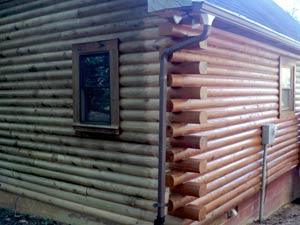
I also used Log End Seal for the logs & Woodsman for caulk touch-up. Our deck and porch floors were treated with Deck Defense. Every single product seemed high-quality and gave the advertised results. The water-based products are a dream to work with and clean-up is easy. All the products used together truly are a log home finishing ‘system’.
Now we have a home with a beautiful finish that looks brand new! My wife says that it looks like we are living inside a piece of fine furniture. The true beauty of the logs is shining through, we have a home we are once again proud of and we could not be more pleased. It was a lot of hard work, but the results are amazing.
I highly recommend Perma-Chink products to all those who want to preserve their logs and want a beautiful home. Their products are not inexpensive, but definitely worth every penny! If you do it yourself or hire it out, make sure you educate yourself on all the excellent how-to’s and advice on the website and make sure the directions are closely followed.

My final advice: You CANNOT go wrong with Perma-Chink.

Some DIY homeowners assume that hot weather simply means that the log finish freshly applied on their log home will dry faster. While this is true, there are circumstances when stained log surfaces dry too quickly. Once the finish is on the wall, it does not really matter if it gets hit by direct sunlight a few hours later. It’s the surface temperature during the application process that’s critical.
How Hot is Too Hot to Stain My Log Home and Deck?
A general rule of thumb is that stain can be applied when the outside temperature is between 40°- 90°F. However, temperature for application is based on the surface temperature of the logs, not the temperature of the air. For instance, a wall in the sun can be 10-25 degrees hotter than the surrounding air.
Can I Stain My Log Home in Direct Sunlight?
It’s best to avoid staining in direct sunlight, especially during the hot summer months. The heat causes the stain to dry out too quickly which prevents it from brushing out properly, resulting in brush marks, lap marks, and inadequate adhesion.
What Part of the Day is Best for Applying Finish to My Log Walls?
For exterior log walls, start as early in the morning as possible, after any dew has evaporated. As the sun rises and areas of the house become shaded, work around the house staining the shaded areas as the sun moves East to West.
What Happens When You Apply Stain to the Log Surface Hotter than 90 F?
- Water-based stains cure by the proper evaporation of water, leaving behind the pigments and protective coating. When water evaporates too rapidly, the ingredients/pigments will not disperse evenly for best adhesion.
- Brush marks and lap marks may occur, resulting in an uneven look of the finish.
- Uneven thickness of the stain coat on the surface will result in blotchy appearance.
Will Humidity Affect the Drying Process of the Stain on the Logs?
The best drying will occur when the relative humidity is 40% to 70%. The ideal temperature for staining is 70 degrees with humidity around 50%. To eliminate dew and condensation on logs that can create uneven sheen, allow approximately 2 hours for the coating to dry before sunset.
PRO Tips for Applying Stain to Log Homes in Hot Weather:
- Work or move around the house to avoid the sun as much as possible. Work in the shade when possible.
- You must keep a “wet edge” at all times. This means a lot of stain on the tools and working fast to avoid lap marks.
- Use heavy duty brushes that hold a lot of stain. Professionals typically use 4” high quality brushes. They are heavy and bulky when loaded with stain. Invest in quality brushes.
- Always “box” your stain and make sure it is completely mixed. Colors can slightly vary from one pail to the next. Use another bucket to mix gallons (like a 5 gallon bucket). Be mindful of the stain in your bucket and keep it closed when taking breaks.
- Buy a laser temperature measurement tool and monitor surface temperatures throughout the job.
- Avoid staining when humidity is extremely high or right after a heavy rainstorm. Stop working if temperatures exceed the limits.
- If in need of a professional help, visit our Find A Contractor tool and choose log home contractors near you.
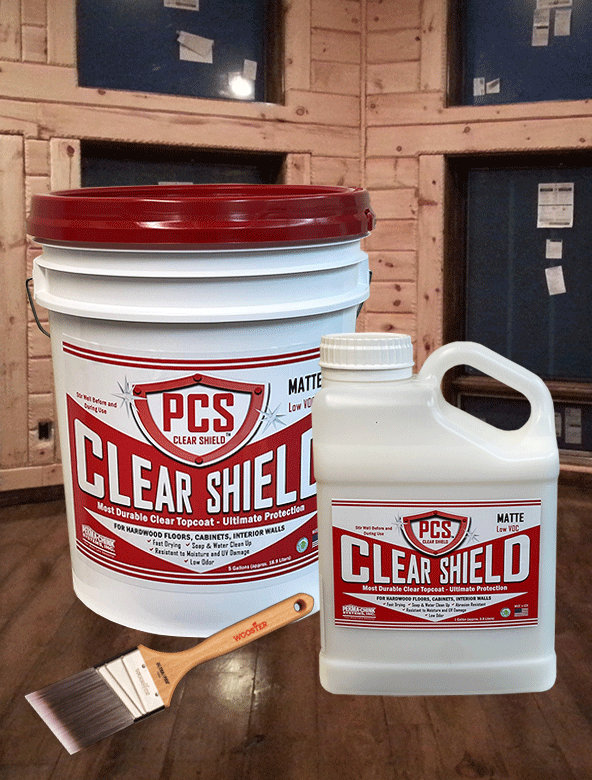
PCS Clear Shield™ Gloss or Matte is a water-based, acrylic latex, interior clear finish for application on both horizontal and vertical surfaces; however, the application of PCS Clear Shield™ is a bit different than our pigmented Lifeline™ stains, and topcoats. Whereas our stains and topcoats should be thoroughly mixed and brushed out as far as they will go, this does not work when applying Clear Shield.
PCS Clear Shield is highly susceptible to air entrapment. That is why the label states to gently stir it using a paint paddle or stick and not to shake or agitate the container as this creates foam that will result in air bubbles within the finish. Vigorously brushing PCS Clear Shield will also entrap air in the finish. For the best results, PCS Clear Shield should be applied with a quality brush or pad using slow strokes.
Another application tip about PCS Clear Shield relates to sanding. Typically, the application of a water-based finish directly to wood tends to raise the wood grain; therefore, the first coat of PCS Clear Shield may not be completely smooth. Allow the first coat of Clear Shield to completely dry before sanding is attempted. It should be dry in approximately 1-2 hours. Lightly sand with sandpaper (180 grit or higher) or a buffing brush to remove the small bumps, ridges, and other imperfections. If the film is just the slightest bit soft, sanding will generate little pills of finish and make a mess of the surface. Once the first coat is sanded smooth, subsequent coats of PCS Clear Shield can be applied without sanding between coats.
Final Note, do not apply PCS Clear Shield to freshly milled lumber as this can result in cracking of the finish as the lumber dries.
If you want a smooth, deep lustrous finish on your interior wood surfaces, PCS Clear Shield is hard to beat. It can also be applied over any of our Interior finishes including Lifeline Acrylic™ Gloss and Satin.